Wednesday, March 3, 2021

A Yankee ...Hard Work and Ingenuity

John Gustafson and family bring us a load of lumber to build the dining room


Chapter 15

 There was so much to improve at camp that I'm sure my parents didn't know where to begin but safety probably dictated one of the first moves. Those naptha Coleman stove and lanterns in the cabins were accidents waiting to happen. Customers were unused to the dangers that came with pouring a highly volatile fuel into a device, then striking a match. If any fuel was slopped on the outside of the tanks, the whole device went up in flames. The lanterns were especially hazardous. If you didn't adjust the regulator properly flames shot high overhead. Here is where those gas lights from the Revolutionary War soldier's home came to the rescue. The problem was they were made for natural gas, not propane.

"We've got to make that little hole -- the orifice -- even smaller," said Dad as he clamped the first S-shaped light into a vice. "Propane is a much higher pressure than natural gas. Fortunately, these lights are made of brass, a soft metal."

He took his nailset out of his carpenter's tool box. With the light held in a vice, he placed the end of the little tool near the hole and angled it inward, then gave it a tap. He then did the same all around the orifice. The metal punch pushed the hole close, a little.

"Let's give this a try."

The next thing was to put fittings on some copper tubing that would screw into each side of a regulator and then into a 20-pound propane tank. This type of connection is done by sliding the fittings onto the tubing, then flaring out the end of the tubing so that when the two fittings are screwed together the flared tubing seats exactly against the contours of the fitting. There is a tool for this, called a flaring tool. We didn't have one of those.

"Here, you hold the tubing tight against the sawhorse and I'll put my plumb bob into it and whack it with the hammer," said Dad. He did and the tubing started to spread. After a half-dozen strikes the soft copper looked like a little horn. We slid the fitting in place and it was really close to being right.

"It will seat better when we screw the fitting together." He connected everything tightly with a wrench and turned on the propane. He sniffed the joints -- nothing. Then he took out his lighter and waved the flame beneath. Nothing.

"We're good," he said.

He then tied a silk mantle on the light and lit it on fire with no gas. It went out in a few seconds. The mantle needs to just be ash to make bright light, he explained. Dad turned on the gas and opened the  control on the light. He lit a match. The flames shot six feet above the light. The orifice was still too large. 

We repeated the above process a couple more times. Finally, the light glowed a brilliant white. One down and eight more to go. Within a couple of lights he could make the orifice the right size in a single attempt.

Hundred-pound propane tanks were brought from town and the lights fitted on the walls of all the cabins. Next, he went looking for cheap propane hotplates. A classified ad from a surplus store in Winnipeg led to getting several cast-iron models. We were in the propane lighting and cooking business.

Our favourite newspaper was the Prairie Farm Weekly from Winnipeg. It had all sorts of helpful articles and advertisements for affordable products, including paint. We got five-gallon pails of it and my Mom and I painted the interiors of all the cabins.

The interior walls were made of pressboard -- like a thick cardboard -- that soaked up paint like a sponge. There were no ceilings in any of the buildings except Bill's old house which we now lived in. Dad would add them as fast as he could over the years.

We needed a dining room in the worst way, so that first year, Dad got a barge load of lumber from John Gustafson in Red Lake and within a few weeks he and Adam Paishk built an addition onto Bill's house, off the kitchen. That 24x24 room became the dining room. Now we had a lodge.

It was near October and we had dozens of moose hunters coming. Mom cooked on the four-burner propane stove we brought from the cabin. It was small but over the years she would turn out pies and biscuits in the oven by the hundreds. Eventually she found a used larger, six-burner commercial stove and the small model went to one of the cabins.

Following Adam's advice, Dad hired a bunch of Ojibwe guides. They had all been born at the west end of Red Lake and knew the area intimately. They also knew something that we didn't know -- how to hunt moose!

The guides were all placed in one of the small cabins since there still was no bunkhouse for them.

The first thing they did was jump in a boat and go looking for birchbark to make into moose calls. It took a wide piece of bark from a big tree. This was folded into a cone and held in place with electrical tape.

Dad sent the guides out in a couple of boats to find dry firewood for the camp. They were back shortly with the boats piled high with cross-loaded dead jackpine. This they cut with a bucksaw in the front yard. The tempered blade of the saw with a man pulling on each end would sing through the dry wood. The two sawyers, kneeling on either side of a sawhorse could cut wood as fast as four men could split it and haul it to the cabins where it was piled in immense rows. We cut wood this way for nearly two decades. 

Two nights before the moose hunters arrived, it looked like one of the guides, Tony Paishk, was on death's door. Adam came to the lodge late at night and said something was wrong with Tony's heart.

Dad went with Adam over to the cabin. He wondered if it might be heartburn. Tony, and the rest of the bunch, had been drunker than skunks when they had come to camp.

Adam said something to Tony in Ojibwe. Tony shrugged and said something back. 

"Maybe," said Adam.

Dad had a small paper roll of Tums in his pocket. Tony unrolled the entire pack and ate the whole works in one mouthful.

"Let's see if that works," said Dad and went back to the lodge. He was wakened an hour later by Adam. Tony seemed worse.

Dad got a can of whole tomatoes from the lodge. "Have him eat these. It might help." Adam didn't come back.

"We've got to get this Tony back to Red Lake," Dad told Mom. But the next day was too windy to make the 20-mile trip by boat. Tony stayed in the cabin while the others worked.

On the second day the moose hunters arrived by floatplane. Dad wanted to send Tony back on one of the planes but Adam said he was feeling better and wanted to guide. Since every guide was needed for each two hunters, Dad reluctantly agreed but secretly vowed to get a replacement the first time he went to town. That never happened.

Tony and his hunters were back before lunch with a moose. A couple of days later they got another. By the end of the two weeks that we offered hunting, Tony accounted for seven moose. He was the best of all the guides.

At the end of the hunt, Tony floored Mom and Dad when he came into the lodge. "Hey, Del and Don, I want to go to town now." After speaking through Adam as an interpreter for three weeks, Tony had finally decided to speak English!

In the next 20 years, Tony would prove himself an exceptional guide although he frequently ended up shooting the moose himself. He had extraordinary eyesight and could spot moose noses looking out between branches of spruces from hundreds of yards away. When he couldn't get his hunters to see the animals, he would say, "Gimme gun!"

The rifle could be bolt action, pump or semi-automatic, open sights, peep sights or scopes, it didn't matter. Tony never missed. This fact was made all the more remarkable by the fact he shot left-handed and his left arm was impaired, the result of being struck by an airplane propeller when he was a firefighter. Tony couldn't wrap his hand around the pistol grip with his finger on the trigger. Instead he held his arm beneath the gun and pinched the trigger against the guard with his finger and thumb.

Tony always shot until the gun was empty. One time, after unloading at something in the vast distance, he reached out his hand and said, "Gimme more shells." The hunter gave him his second clip. Tony blasted away but then stared for awhile at the bush two hundreds yards away. "Gimme more shells," he said. The hunter reloaded the first clip. Tony shot some more. The hunter said later there was absolutely nothing he could see that Tony was shooting at. 

After waiting a bit, they went over to the spot. There were three dead moose, a bull, cow and a calf.  Party hunting was legal in those days so all the moose were legally claimed by the party of hunters.

...to be continued

More in this series:

Bullies
Wolverine

Roots 

Racism 

Animals 

Mentors 

School

Lots of Bugs


Friday, February 26, 2021

Rainbow Smelt and Aurora Borealis


 The frailties of the human mind are revealed in these two stories.

When we came to Thunder Bay in 1979 I was eager to try smelting in the spring. With the first warm nights, everyone, it seemed, would stay up late at night along the shores of all the rivers and creeks and dip out the small silvery fish that had come ashore from Lake Superior to spawn. They were so abundant that in our first smelting trip, Brenda, our four-year-old son, Matt, and I discovered that one swoop of the net got more smelt than we had use for.

They made a good fish fry when fresh but weren't our favourite after they had been frozen. In the couple of years that followed we just kept those fish that Matt could catch with his bare hands. He would stand in the creek in his little rubber boots with me steadying him while the fish flashed by him by the millions.

By the time Matt was 6, however, we just couldn't repeat the performance. The smelt only run for about a week, so we thought we had just picked a bad night. However, when he was seven and eight, our bad luck continued.

I was an outdoor writer for the newspaper at the time and so asked the fisheries biologists if they could shed light on the subject. Actually, they said, there were no smelt runs occurring in the Thunder Bay area at all.

The runs take place in a pattern that circles the big lake about every 10 years. So, there might be a small run one year in Thunder Bay, followed by a tremendous run and in the third year, a small run. Then nothing for about a decade while the fish made their way around the world's largest lakeshore. Even though I reported all of this in the newspaper, most people seemed to not have gotten the news. They went smelting every year.

"Hey, Dan! Are you going smelting this weekend?" they would say, during those years when the run was happening on the other side of the lake, in Michigan.

Uh, no, I would reply. Are you?

"Absolutely! We go every year. We just love it!"

How did you do last year? I would ask.

"Last year? Hmm, I think we missed the run."

And the year before that?

"We seemed to have missed it that time too," they would say.

But the fact that they didn't catch anything, anything at all, hardly seemed to matter.

The banks of the creeks were lined by laughing, drinking revellers, dipping the empty water by the thousands, night after night, year after year. What great fun! Getting wet in the icy water, then drying off by a bonfire with a beer in hand.

It just never occurred to any of these people that there actually weren't ANY smelt out there. To them it just seemed chance when they "hit the run." They never noticed that event was 9, 10 and 11 years apart.

Now, what about the Aurora Borealis or the Northern Lights?

I grew up with the Northern Lights overhead at night. Not every night but frequently. Sometimes they were spectacular; sometimes they were faint. But they were fairly dependable at making an appearance.

Not any more. I saw a faint display a few nights ago and that was the first time I have seen them in about three years. People just refuse to believe this is so.

"Oh, you are just getting old. You go to bed early before the Northern Lights appear," they say. Or, "when was the last time you had your eyes checked? Maybe your eyesight is failing."

I do go to bed early but I also get up early, frequently before sunrise. There are no northern lights out there. Not here in Northwestern Ontario anyway.

If you want to see what northern lights look light, watch the flames flickering in the wood-burning stove while the Steel Drivers sing a bluegrass song. That is about as close to the real thing as you are going to get.

How can this be? The Aurora Borealis are gases at the outer edges of our atmosphere that are energized by radiation from the sun and fluoresce. That particular ionizing radiation is released when there are lots of sunspots which are storms on the sun's surface. Guess what? There are no sunspots occurring!

This isn't unheard of. In fact the sun goes through regular 10-year cycles of high activity and lulls. Incidentally, besides intense Northern Lights, the highs are marked by hot weather extremes here on Earth. These often mean bad forest fire years in Northwestern Ontario.

We are currently in a lull but it is not the usual 10-year doldrum. It's a multi-decade lull of near-historic proportions. The last time the sun was quite so quiet was during the last mini-ice age. In other words, the climate that we are currently experiencing -- the climate that is getting dramatically warmer -- is actually taking place during an exceptionally cold time for the planet.

Wait until the solar activity returns. "We ain't seen nuthin' yet."


Monday, February 8, 2021

'I Saw the Light'


What a tremendous amount of sunlight the days are bringing now

It is the coldest morning of the winter, -32 C plus enough wind to make the weather service sound the alarm about -40 C windchill.

The winter, the cold, the pandemic and just the uncertainty of things make us feel like we are bearing an enormous weight. For me, those symptoms of depression mean it is time to do something. For starters, let's just look where I am right now -- sitting in our sunroom at 9 a.m. and the sunlight is flooding me with its warmth. The days are much longer now and even though it is cold outside, the sunlight feels great.

Sunlight is such a wonderful thing. I heard someone from England on TV refer to places around people's homes that are sheltered from the wind and that face the sun as "sun traps." I like that. Even here, with the -40 C temperature, if I put my hand against a dark object that is facing the sun, the object is warm. I like to find our "sun traps" and stay there as long as I can with my face beaming back at the mother sun.

Lots of our friends and family in the States now report getting their covid vaccines. Way to go! That is tremendous news. It is slower for us here in Canada because we don't have any vaccine makers in the country; however, some vaccinations have already taken place. A real surge in vaccinations is expected to begin within a week or so. Everybody is supposed to get theirs by September. My guess is it will actually happen several months sooner. That should mean the border will open again. Hurray! 

Probably preventative measures like mask wearing will continue for awhile but so what? I've got no problem with it. The quicker we pound the virus into submission the better. Let's hit it with everything we've got.

I look at mask wearing-rules the same as those for public nudity. It just helps things run smoothly.

Incidentally, here in Canada we are not as uptight about nudity as people are in the States. I think the reason for that is our climate and bugs. Anyone who goes nude here deserves some admiration just for their toughness although their intelligence is, of course, suspect.

Anyway, cheer up everybody! Spring is just around the corner!


Monday, February 1, 2021

What a simple cabin water system


Tiny Shurflo pump produces four gallons per minute

When we were planning our cabin for Red Lake a few years ago I talked with a merchant in Red Lake who sells solar products. I was planning on mounting a big water tank on the hill behind the cabin that would feed by gravity. I wondered if there was a solar pump that would fill that tank. If not, I would use my Honda fire pump.

"Please, don't do that," said the man. "Try this system instead."

So last year, even though we only have the smaller "dockhouse" finished, we bought his system. It consists of the little pump shown above, a 12-volt battery, a small solar panel and a small charge controller. The whole thing, except for the solar panel, will fit inside of a plastic tote. The solar panel can be mounted to the top.

We hurriedly installed it, just to save carrying water pails from the lake to the dockhouse. We just have a single water tap inside. 

It worked like a charm although we were never able to connect the solar system. We were missing electrical connectors and the wire we had was too heavy to wrap around the little screws on the charge controller. So we just attached the pump to the battery. It has an automatic pressure switch built in. The pump comes on when we run the tap and supplies four gallons of water a minute. That's enough even for a shower. When we get the bigger cabin finished it may be necessary to add a pressure tank to keep up with demand but right now, that's all the water we need. 

I charged the battery with our generator only twice during the time we used the pump. It ran about two weeks between charging. The battery charger showed the battery really hadn't discharged very much in that time.

I was stumped when I went to attach the intake and discharge lines. None of my half-inch fittings would work. Finally Brian from the camp looked at it and realized it actually was made for Pex pipe. He gave me some clamps and his Pex tool and we were in business.


Wednesday, January 27, 2021

A Yankee in the Canadian Bush - Bugs

Old Cabins 1 and 2 surrounded by long grass


Chapter 14

Job No. 1 when my parents took over Bow Narrows Camp was to deal with the bugs. The black flies and mosquitoes in the yard were intolerable. It was impossible to sit outside without being devoured. So what to do?

The answer was to create those conditions that the insects avoid and eliminate the ones that they prefer. Small insects like black flies and mosquitoes fear drying out. They avoid bright, windy areas and hang back in the shade.

Bill Stupack would cut the grass around the cabins once or twice a summer with a scythe. That long grass was a bug heaven. So was the dark bush which surrounded the camp. 

The Lawnboy lawn mower we had brought from Pickerel River was a godsend. It was exceedingly sturdy, suffering strikes against hidden rocks and stumps without bending the driveshaft. Dad was meticulous in cutting as close to the cabins and trees as possible, eliminating these small but important shade spots.

Next, he started clearing land. Eventually, after he had bought the property all the way down the lakeshore to Cabin 10, he opened up everything as much as possible, letting the west wind sweep down the peninsula from Trout Bay. The difference was like night and day. Having a shade tree here and there was fine, as long as we were able to cut the grass beneath it regularly. You didn't want enough trees to make a windbreak as that would become a bug breeding ground.

Before the clearing program, Dad and I went outside the old lodge -- now Cabin 3 -- one evening just before dark. We were still right at the door when Dad spotted a really big bear (another reason to keep things open -- you can see the bears). The immense bruin started right for us, its head low to the ground. It was the most blatant example of predatory behaviour I have ever seen.

"That boy's got to go, right now," said Dad. "Quick, get back into the house."

Mom and I closed all the windows, even though it was July and stifling hot.

Dad loaded his .308 and doused himself with Off, then stepped outside the door to wait for the bear. He was back inside in just minutes; the mosquitoes were so thick he couldn't breathe. They droned so loudly you couldn't hear anything else.

Dad got a can of molasses which he poured on the ground right in front of the window in the hallway where I slept. He slid the window open.

"You get up on your bed with the flashlight and when the bear comes to get this molasses, I'll give you the word. Shine the light over my shoulder, across the gun sights and onto the bear. I'll shoot right through the screen. It will just make a little hole that we can patch with a piece of tape."

Even with a big nasty bear at hand, Dad realized the importance of the screen against the bugs in the hot weather.

We probably saw the bear a dozen times, his long legs letting him stride quickly around all the cabins. He never stopped moving, probably because of the mosquitoes. It was dark now but there was a bit of moonlight.

There was no one else in camp but Dad, Mom and me, which was a blessing.

At long last, the bear came right to the molasses and Dad shot, never telling me to turn on the light. The bear was only four feet away, he said later. He couldn't miss.

The sound of the gun inside the little room was incredible. There were two guitars hanging on the wall behind me and they were ringing like the bells of Notre Dame Cathedral.

The bear ran and Dad opened the door and went after him. I was right behind with the flashlight.

We found the bear, dead, at the bush line. I could still hear the guitars ringing. Dad opened his mouth but couldn't make any sounds. 

"What?" I tried to say, but I couldn't make any sounds either. I saw Dad mouth the word, "What?"

We were both totally deaf.

The mosquitoes were eating us alive so we hurried back inside. Dad grabbed a roll of electrical tape to patch the .30-caliber hole in the screen. To his chagrin he found that in addition to the little hole, the muzzle blast had blown three sides of the screen off the window. It was hanging like a flap. It wasn't until midnight that the guitars stopped ringing in my head.

The next day we went to look at the bear. It looked like a black polar bear -- very long body and neck and a small head. In the middle of the summer like this it's hide was worthless. There was nothing to do but throw the bear away.

We wished our guests could have shot it during hunting season but we had no other choice.

It was the most dangerous bear I have ever seen.


Tuesday, January 26, 2021

Following the trail once most-travelled

 When we retired five years ago after operating Bow Narrows Camp for 26 years a lot of our friends thought we looked forward to finally being able to go fishing. I do like fishing a bit but after cleaning about a million of them in my time and listening to our guests talk about fishing continuously for years, it was really the non-fishing things I wanted to do. I think Brenda feels the same.

Like what? you might ask.

Well, I would like to find and put on a map some of the First Nations trails that once crisscrossed this country. When I was a kid growing up at Bow Narrows, the native people could walk from place to place just about as fast as they could paddle a canoe.

One time Brenda, my Dad and I had just come into Red Lake in early May, ready to fly by floatplane from open water at the Chukuni River to a hole in the ice at the narrows in front of camp. It was warm and sunny and the ice in the entire lake was probably only days away from disappearing. 

Ed Paishk, who along with his brother, Tony, worked about every fall at camp as moose guides, kept following my Dad everywhere he went in town. Ed was drunk and was slurring his words so badly none of us could make out what he was saying. In all likelihood, he wanted to bum some money for more drink as this was the custom of most of the guides.

We were in a hurry as the plane was waiting over at the river. It was about 9 a.m.

"Ed, we've got to go but you can tell me all about it next time I see you," said Dad, getting into his car and driving off, leaving Ed weaving down the street.

We got out to camp by about 10 and slowly worked all of our possessions and food boxes up the hill into the lodge. Around 4 p.m., Ed came walking out of the bush from behind the camp.  He might have gotten a ride out to Madsen, but would have had to hoof it from there. This was before the Suffel Lake Road had been made. It was at least a 16-mile walk and would have meant walking completely around Trout Bay, then down the four-mile peninsula that has camp at its tip. Ed had made the trip in about six hours and had sobered up on the way.

"Hey, Don," said Ed. "I was charged for a sleeping bag last fall but I left mine in the bunkhouse."

Ed had his payslip from last fall in his hand. Dad would buy all the guides sleeping bags and charge for them only if they took the bag with them at the end of hunting season. Dad owed Ed $16. He took out his wallet and paid him.

"You want to stay here overnight..." he began to ask but Ed was already disappearing back into the trees.

Another time Dad had all the guides into camp the week before moose season and wanted them to scout around for moose sign. Some of these men had never been to camp before but finding their way just didn't seem a problem for the Anishinaabe.

There was a big map on the wall and Dad pointed to a lake on it and asked two of the newbees to go check it out. A creek ran about a mile from the little lake into Red Lake. One of the guys was tracing his finger along the creek, making a mental picture of the map, when Tony Paishk spoke harshly in Ojibwe to him. I think the gist of what he said was, "Only a dumbass slogs through the swamp and tag alders. There's a ridge right over here. Follow it north until it ends, then go east to the lake." The man nodded.

Tony had been born not too far from this place and probably had been to this and every other lake in the whole region from every direction many times in his life.

I was probably 13 or 14 at the time and somehow managed to weasel my way onto the scouting trip.

When we put our boat ashore at the end of the creek, the two men and I climbed our way up the rocks to the top of the ridge. We hadn't gone far, just picking the easiest places to walk when we hit a trail worn into the moss. The trail would disappear at times but we would eventually pick it up again. Finally we came to the end of the ridge and the men looked around until they found the trail down. From there it was nothing but swamp and tag alders a couple of hundred yards to the lake. It would have been a miserable place to hunt. We retraced our steps and this time, found the easy trail off the ridge, not far from the boat.

Dad asked me later what the trail had been like.

"I'm not sure it was even made by humans," I remarked. "I think it might just have been a game trail."

"Well, they're not mutually exclusive," said Dad. "Everything takes the easiest route."

That lesson came to mind one time when I was hunting with my brother-in-law, Gord, down near Thunder Bay. We were going to take a compass route back into a lake. I was following Gord because he was a whiz with a map and compass, having done it all over Canada since he was a high school kid working for a mineral exploration company.

We were heading straight south when we came upon a moose trail. Gord immediately followed it. It was easier walking for one thing. The problem was it was headed more or less west, right-angles to where we were going. After awhile it swung south again. I was getting worried. I caught up to Gord.

"Gord, I thought we were heading to that lake," I said.

"We are. I think the moose trail is going there," he replied.

"What makes you think that?" I wanted to know.

"Where else would it be going?" he said. "Moose have some place in mind when they make these trails."

Five minutes later we came out on the lake.


Monday, January 4, 2021

Checkout this comment for gray, red foxes

 Rob Foster left an illuminating comment about gray foxes and red foxes on one of this blog's postings from 2018. In particular he gives a link to a DNA study that shows there have always been red foxes in North America.

Another cougar filmed in Thunder Bay area

 A man in Slate River Valley, about 10 miles from Nolalu, got a video of a cougar on one of his trail cams, Dec. 31. It is the second recording of the big cats in the area this winter. The other came from Kaministiquia, also about 10 miles from here but in a different direction.

I really think now the big cat I saw a couple of months ago was likely a cougar. It was a couple of hundred yards away in our field and seemed the length of a big German Shepherd. It was tawny in colour and moved like a cat. But since I never saw a tail, I put it down as a humungus lynx at the time.

Here's a link to CBC Thunder Bay with the video


Thursday, December 24, 2020

When the snow lay round about, deep and crisp and even


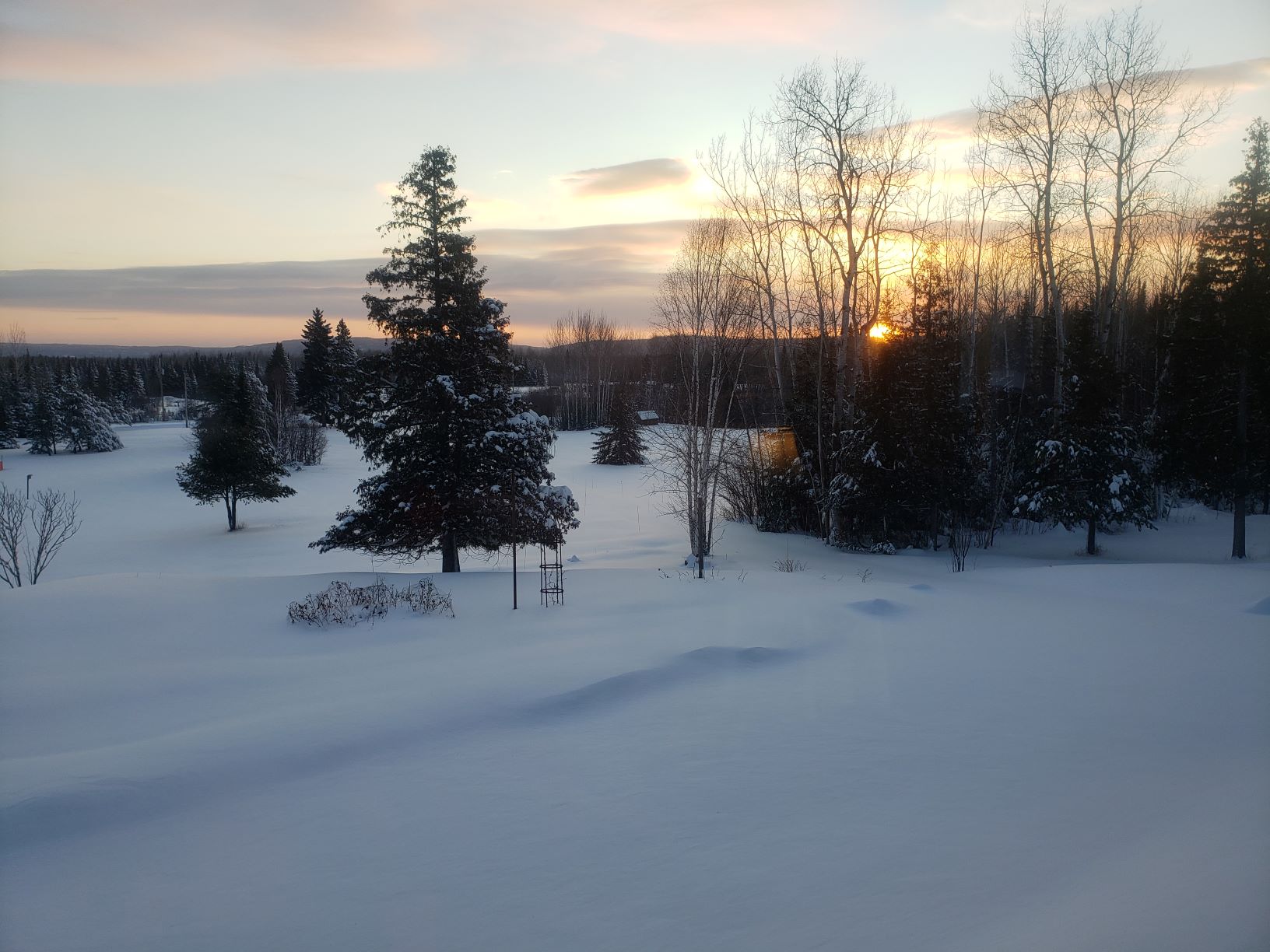
Sunrise on the day before Christmas reveals a newly fallen 20 inches of snow

First use of the Kubota tractor and its snowblower this winter

Even, except for the drifts. They sort of undulate.

We just had two days of snow here in this part of Northwestern Ontario and the result is 40-50 centimeters  (18-20 inches). And just like the song goes, it is crisp, -22 C or about -5 F. It was our first major snowfall of the winter. I had only put the snowblower on the tractor a day earlier.

We weren't in danger of having a brown Christmas, however. There were about three inches of white stuff that had gradually accumulated over December before the big blast.

Say, did you see the conjunction of Jupiter and Saturn? Me neither. It is preordained that celestial events like this only happen during cloudy skies.

Brenda and I wish you a safe Christmas. That is about the best we can give each other right now. We will make merry next year.


Sunday, December 20, 2020

Is that a wolf or a coyote?

Taller, heavier canine is certainly a wolf

Smaller animal is a coyote although a big one

 When you see one of these canines by itself, it isn't easy to tell which species you are looking at. Is it a big coyote or a small wolf, or the opposite? Some of my decision-making comes from the animal's behaviour. Coyotes are far more likely to be seen in the open, in fields, than wolves which stick to the heavy cover. Still, even wolves must cross roads and if you see them doing it, what were they?

One of my trailcams caught both a timber wolf (aka grey wolf) and a coyote at different times but in similar positions and light. The coyote is the same animal shown a posting or two back crossing our field. It is a BIG coyote. It reminds me of the Littlest Hobo. The wolf is obviously heavier and larger and he too is of good size, probably larger than average. His tracks are about four inches wide. The coyote's are just two inches.

Some timber wolves reach extraordinary size and I have never heard a good explanation for it other than it must just be the genes. These wolves measure eight feet from nose to end of the tail, stand about four feet tall and have footprints nearly six inches wide. They are "super wolves."

Wildlife biologists I have spoken to don't seem too interested in the size disparity which baffles me. The super wolves are double the size and weight of ordinary wolves. What if they were a game species? Would a biologist study whitetail deer that reached 600 pounds? 

A super wolf crossed the road right in front of Brenda's car one time and she gasped at its size. When the canine's nose was at the center of the road, its tail was still at the shoulder. My God!

Lots of people wonder what wolves and coyotes weigh. The wolf in the photos might be as heavy as 120 pounds. I would say the average wolf would be more like 80 pounds. The "super wolves' can weigh 200 pounds.

The coyote pictured is probably about 40 pounds.


Same wolf as top photo but at a different location and better light conditions


Wednesday, December 2, 2020

Something to ponder this Christmas


If I could give all the people of Canada and the United States a gift this Christmas it would be this: understand the difference between morality and ideology.

If we could all clearly make that distinction I believe we would immediately begin to make the world a better place.

I bring this up now because it is the "Season of Giving." No child should have a Christmas without a gift. No family should have a Christmas Day without a feast of turkey and cranberries. Undoubtedly all true. Our moral backbone won't stand for anything less.

And the rest of the year? We become spineless jellyfish. We let ideologues tell us how to think and feel. These can be politicians, business leaders and their associations, even clergy. They tell us that people are homeless because they are lazy and don't want to work; that people are hungry because they would rather be addicts. This is ideological nonsense. 

Let us give ourselves a gift this year. Let us give ourselves a voice to shout down these nincompoops. Let us build our nations up on morality. That is what Christmas is all about. Peace and Love. Every day. Every occasion. Every choice.


Grey fox a nightly visitor now


 This Grey Fox visits our bird feeder every night. It is a new species for us, probably an example of climate change.

Wednesday, November 25, 2020

It has been an awesome year for predators

Click on this for a better view. Isn't this a gorgeous coyote? He is crossing the field right in front of our house.

Every day, it seems, we spot a new predator near our house. Last night it was a grey fox, the second time we have ever seen this small canine. It was the last of the possible canines to see. We've already spotted timber or grey wolf, eastern coyote and red fox.

I have gotten trail camera pics of a Canada lynx, Canada fisher and marten (aka pine marten.) I have seen the tracks of the least weasel. We also had three bears here in the early fall.

About the only thing left in the four-legged category are bobcat (rare here) and, possibly, the even more rare eastern cougar. I personally place the cougar in the myth category even though I saw something last week that made my heart jump. It was a cat, seemingly too large for a lynx, walking across our field in late morning. I strained my eyes for a long tail -- that would clinch it as a cougar but alas, I couldn't see one. So, I have put it down as the largest lynx ever.

************************************

Update Dec. 15

A man got trail camera photos of a cougar in Kaministiquia. It was on the TV and radio news.  Facebook too, I hear. That is only about 15 miles away! Maybe that was a cougar I saw after all. 

************************************

 I guess a wolverine isn't beyond the realm of possibility too. I would be thrilled to see one. I have a friend who lives about 15 miles away who found wolverine tracks in the snow last winter.

Then there are the avian predators.  It started with a northern shrike. I saw it nail a junco right on the driveway. Next we had a sharp-shinned hawk terrorizing the pine grosbeaks at our feeders for about a week. Six of the panicked birds flew right into the windows of the sunroom and killed themselves. I think the hawk might have gotten an equal number on the wing. The sharpie disappeared right after I saw what can only be described as a white feathered missile. It went by our house and into the bush after the sharpie like a blur. I could only see that it was flying, not diving, and was mostly white.

It was way, way too fast for a snowy owl. The only two falcon possibilities are goshawk which I have seen a few times in my life and gyrfalcon which I have never seen. In reading up on the subject I suspect it was a gyrfalcon -- the fastest bird in the world for level flight. It hits 50-68 mph on the level. By comparison, the peregrine falcon chugs along at about 60. However, the falcon can dive at 242 mph, making it the fastest creature on the planet.

My mystery hawk was flying, not diving, and went across our yard and into the trees after the sharpie in a blink. So gyrfalcon it is, maybe.

*******************************

Update, Nov. 30.

Saw a goshawk in the same spot as the above sighting; so, it is almost certain it was a goshawk I saw the first time too.

*******************************

At night we have the owl set working around the place. I have heard great-horned and barred owls frequently and found the gut pile of rabbits they have eaten.

No doubt the little saw-whet is in the bush behind the house too. Good luck seeing that one. However, next spring he might give himself away when he starts with his "back-up" alarm call.

Monday, November 23, 2020

Pack of coyotes a Nolalu first


 In the 35 years that we have lived in Nolalu I have never seen more than one coyote at a time. The same holds true for my trail cameras. Every coyote photo has been of a single animal, never a pack. That has changed suddenly.

I got my first photos of at least three of the wily canines traveling down one of my trails. I didn't use any of those shots here because they were taken at night and weren't the best quality. But here is one of the pack in the daylight.

I was first alerted to the presence of coyote packs about six weeks ago when I heard them yipping at night. We normally hear timber wolves, not coyotes. 

We live right on the edge of coyote country. Just a few miles east of here coyote packs are the norm and wolves the exception. That is probably because there is more farm country to the east. Here it is mostly bush.

I had just gotten the pics of the coyote pack on my trail cam when I noticed dozens of coyote tracks right around the house. What were they doing here? My best guess is they were after a red fox that had been coming to our bird feeder. 

The next thing was I spotted a big coyote walking in the field right in front of the house. There was a large whitetail doe eating at the feeder at the time and while she didn't instantly bolt, she was alarmed and moved off as soon as the coyote went out of sight. 

Meanwhile wolf tracks are few and far between. My conclusion is that something has happened to the wolves and the coyotes have filled in the void. We haven't seen the fox recently either.

Wednesday, November 18, 2020

A Yankee in the Canadian Bush - School


 Chapter 13

I went to school by correspondence from Grade 3 through Grade 8. This was part of the Ontario Department of Education system for kids like me who lived where there were no schools. It was nothing like home school is today.

Each month I received in the mail large manila envelopes filled with that month's lessons. At the start of the school year I would also get boxes with textbooks as well as art supplies and materials to do upcoming science experiments. The lessons were the same as the core curriculum in the schools.

The lessons were arranged for each day of the school week. For instance, I would have printed lessons that said: Monday -- Science, followed by Monday--Writing, followed by Monday -- Art and then Monday -- History, etc. There were chapters to read in the books, then questions to answer and problems to solve, maps to colour and sentences to parse.

It was so cool! I loved it! 

I would sit by the oil stove in the dining room at camp and would lose myself in all this new information. My mom soon learned that rather than push me to "go to school" she had to slow me down. I would get so engrossed in a subject I would ignore what day it was and just keep going. Within a few days I had done the whole month.

"Oh my goodness!" she would say. "You did it all! You're going way too fast. It's not a race, you know."

She would review what I had written and say, "You better go back and check your answers."

Mom thought it best if I maintained the same schedule as kids did in real school. So, I started at 8 a.m. and had recess at 10, lunch at noon, recess at 2 and finished for the day at 3:30. The only difference for me was that I took my .22 and went partridge hunting during recesses and would throw the whole schedule out the window when I heard a boat coming back to the dock.

"Tony's coming in with a moose!" I would yell as the screen door slammed behind me.

At the end of the month I would send off my completed work in the postage-paid envelopes provided. I had a teacher who would mark or grade my work and return it in the next mailing of lessons. She would make comments just as if she was in the room. 

"Danny, you have a great imagination and that comes through on your story about the red fox. You could make it more interesting to readers by thinking of different words for "fox" and "mouse" when you repeat these names. You can get some ideas by looking up these words in your dictionary. Keep up the good work! You have the makings of great writer!" -- signed Mrs. Peters.

Huh! Different words for fox and mouse? I got out the dictionary. Well, I'll be.

By erasing a little my story became, "The hungry fox stopped its long nighttime hunt when it found mouse holes on each side of the snowshoe trail. The vixen ..." no wait, "... the clever vixen knew it was just a matter of time before a rodent would appear and provide breakfast."

Ken's Lodge, 1963


School became even more interesting when we moved into town for the winter. We lived at what was then called Ken's Lodge on the west side of the Forestry Point. Today this camp is called Sunset Lodge.

The lodge was on the western outskirts of town and was meant to be used just during the summer. We lived in the owners' quarter rent-free in exchange for my dad putting up ice in the camp's icehouse.

The arrangement worked pretty well except for the fact the building was uninsulated. That would prove interesting for us when the temperature dipped to forty below zero. For obvious reasons, the building's water system was disconnected in the winter. We got our water by walking down to the lake and chopping a hole in the ice. We quickly learned to cover the hole with a wooden box and tarps so there would only be two inches of new ice the next time we came instead of two feet.

There were two ways to heat the living quarters -- a DuoTherm oil stove that was identical to the one we had in the dining room at camp, and a tin airtight woodstove, just like we had in the camp cabins. Both systems ran full-out all winter.

The first time the deep cold hit in January, the oil stove quit working. Dad figured the problem was caused by "summer" oil which contained wax that would precipitate out when the temp was less than 20 below. He wrapped the oil line with an electric heat-trace wire and plugged it into an outside outlet. It worked.

The oil stove sat in the living room while the wood stove was in the walkway between the kitchen and the living room. There was a counter peninsula between the wood stove and the kitchen sink, 10 feet away. The dish cloth would freeze to the sink. The sink drain was disconnected and we collected the water in a five-gallon pail. When we dumped this outside the back door it instantly froze, making a little glacier that increased in height each day.

A stairs off the kitchen led to the bedrooms. My parent's room was right at the top of the stairs where heat from the stoves below would find its way. There was also a heat-collecting device on the wood stove chimney. The temperature in this room was usually above freezing but not by much. There was a cot in this room that I could use but I preferred a second bedroom which didn't get any heat from below. The temperature in there wasn't much different than outside. There were probably six blankets and sleeping bags spread open on this bed. I would get things warm by heating rocks atop the wood stove and then wrapping them in towels and putting them in the bed a half hour before I got in. I wore long underwear and two pair of socks. I pulled my head under the six inches of blankets to keep it from freezing. It sounds awful but actually I slept very well there. Sometimes though when it was near 50 below and the house was cracking, Mom insisted I sleep in their room. 

Our winter quarters had hydro (electricity) which was something we didn't have out at camp. There was no television in Red Lake in those days so people had to make their own entertainment. Churches held teas regularly, there were lots of dances and just about everybody was involved in hockey, curling or bowling.

"True Canadians like winter better than summer," my dad said one time. I don't know where he got that fact and it is disputed to this day by my wife, Brenda, who is about as Canadian as you can get but for me, those first winters were indeed what led to my Canadian citizenship. It started with learning to skate.

I had several friends that lived within a half-mile and every one of them could skate like the wind, or at least that's how it seemed to me. I couldn't take a step without falling on my butt or my face. I was determined to learn. So I took the snow shovel and cleared the snow off the lake in front of the cabin. It took days but eventually I had made a small rink. Mom got me a pair of used skates and watched as I walked out on the ice only to see me fall again and again and again, for days. I fell forward and backward and sideways. I did the splits. I hit the front of my head and the back of my head. I had bloody noses and split lips. One night I was taking a bath and Dad laughed, "Your bruises have bruises. Even your ears are swollen."

By the end of the week, I could skate, even backwards, at least a little.

There were no social functions on Saturday night. That was Hockey Night in Canada and we all had our ears glued to the radio to hear Foster Hewitt call the game. 

"Hello Canada and hockey fans in the United States and Newfoundland," he would always say.

The Toronto Maple Leafs were everybody's favourite but personally, I preferred the Chicago Blackhawks. I liked their logo better. It was a noble looking Indian man and reminded me of Tony Paishk.

Bobby Hull played for the Blackhawks and he was a sensation. He had a slap shot that traveled 100 miles an hour! Incredible. That would be faster than the eye could see, I thought. I wanted to practise my slap shot but that was difficult because there were no boards around my rink. If I whacked the puck at more than a few miles an hour it just disappeared in the snowbanks and was lost forever. But I found a piece of plywood and stood it at one end of my rink and shot at that. Mostly I missed and the pucks were never seen again. It would be two weeks before I could get another puck; so, in the meantime I would have to content myself with shooting chunks of ice around. 

I would often stay out on my rink after it got dark even though there were no lights. For one thing, it got dark about 5 p.m. In the winter, with everything white from the snow, you can see quite well at night. As I skated around, doing step-overs on the corners and picking up speed on the straightaways, the ice would rumble like thunder as it froze deeper and deeper. Northern lights would appear in the sky and crackle like tinfoil being shaken. Some people said they couldn't hear them but I swore I could.

Dad would park the car up at the garage at the top of the hill and walk the 100 yards down to the camp on a snowshoe trail we kept well-packed. Mom would then call me for supper and I would walk up the trail to the house where I would take off my skates and wince from the pain as feeling came back to my feet. What a great life, I would think.

I absolutely devoured my school work. There wasn't much else to do anyway. I wondered about other kids enrolled in the system. We all sent our pictures so others could see us and we were encouraged to become penpals. There were only a couple dozen of us. I got the impression that the kids all had white fathers and Indian mothers. We were spread out from Hudson Bay to Red Lake. 

There were certainly more than two dozen Indian kids on traplines in Ontario's North, I guessed. Were they able to go to regular schools? My best friend was Stanley Keesic who lived over the hill from Ken's Lodge. We were in the same grade and he went to regular school in town, coming and going on the bus. Other Indian kids went to the Mennonite School on Forestry Road. It would be decades before I learned where most Indian kids in remote areas were sent -- the infamous residential schools.

My Mom, God love her, continually worried that I wasn't getting a good education. Knowing that I was breezing through my correspondence classes, she would also enroll me temporarily in local schools, including those in Ohio when we went to visit my sister and her family. So I might attend two schools -- Red Lake and Ohio -- plus do my correspondence work in a single school year. She also worried that I wasn't socializing enough. I don't know why she felt like this as I had many friends in Red Lake -- virtually all the kids in the vicinity of Ken's Lodge plus, eventually, several close friends at Red Lake Public School and the kids who came year after year with their families to camp.

By popping me in and out of schools, particularly in Ohio, I did indeed learn one thing: there were bullies in every school. I learned to recognize them immediately; they were the biggest boys who had failed several grades and were a head or two taller than everybody else. They had a universal routine --  humiliate and torture smaller boys. If you stood up to them, they would order you to meet them after school or on the weekend when they would be accompanied by two or three bullies-in-waiting.

I was no milquetoast but there wasn't a remote chance of winning these fights. Even though Dad had shown me how to box it was just impossible. The bully would be a foot taller and twice my weight. If ever I did get in a good lick, the bully lieutenants would grab my arms and let the big bully pummel me. Bullies only pick on people they know they can beat, the more helpless, the better. Why do they do this? Because they are sick sadists. And they aren't alone. There is an endless line of succession of little bullies waiting for the big bully to finally graduate, or get a job, or become president.

I thought and thought and couldn't see a solution. I didn't want to be bullied all my life. I was sick of it. And then, one day, the answer came "out of the blue." It was, I would learn decades later, a Superconscious answer. What is the Superconscious? It is when there is an answer to a problem that is a blinding flash of the obvious, that takes into account not just every known fact but, curiously, at least one thing you didn't know. It is always accompanied by a feeling of warmth, of elation, and you know in your heart that it is the right thing to do. There is another part of a Superconscious decision: it must be acted upon right away.

So, the next day, without hesitation, I did it. The school day was beginning and I had just gotten off the bus. As I walked down the corridor toward my locker I had to pass the big bully yucking it up with some bully wannabes. He was taking something out of his locker when I tapped him on the shoulder. As he turned I punched him with all my might in the face, a sucker punch. That was one part of the solution; bullies don't fight fair but they expect you to. Well, not this time and not ever again. 

Brutus went straight to the floor while blood spurted from his nose. I kicked him hard in the gut and he twisted away from me in the fetal position so I kicked him several times in the butt.

"Get up, fatso!" I yelled.

The junior bullies shielded him as he got on his feet.

"You're dead meat!" he yelled. "Meet me after school!"

That brought up another part of the Superconscious solution. Bullies are afraid of being thrown out of school. If they are expelled they will get a beating from their old man. Not my problem. And I couldn't care less if I got thrown out. This was my ace-in-the-hole.

"Hey, I'm here right now. Come and get it unless you're chicken."

Big Dummy didn't know what to do. I started clucking.

"The kid's a psycho," said Bully No. 2.

Yeah, that's it. Nobody can beat a psycho. Whatever.

The next day I was ready to repeat the performance, only this time the group saw me coming. I walked right up and started clucking. 

The day after that there was no group in the hall.

...to be continued

Others in this series

 Prologue

Bullies
Wolverine 

Roots

Animals

Mentors


Reduced version of blog is back

 Thanks, everyone, for your advocacy. This pared-down version of the blog is what I am comfortable leaving public in today's situation. ...