 |
| Roof trusses are up, thanks to all the BNC staff |
 |
| Work is progressing on our cabin |
In other news, Red Lake's water level has fallen by more than a foot now and Red Lake Marine is getting its docks back in shape.
 |
| The other route, Hwy 601, map available on Red Lake site |
I got word late Wednesday that the ice disappeared in the Stretch, Red Lake's largest water body just west of Howey Bay. So that is ice-out!
That was followed by an update from the Town of Red Lake that Quibell Road Detour is temporarily closed. It may re-open tomorrow, May 19.
I will not give any other updates on road conditions because changes are happening so rapidly.
There are no ifs, ands or buts, get the Ontario 511 app. It has up-to-the minute road conditions, including accidents.
What a crappy spring!
There is still ice in Red Lake. It is cold and rainy today and the lake is flooding. My prediction of May 22 for ice-out might still become a reality.
If you are traveling to Red Lake for what is supposed to be opening weekend of fishing, May 21, be advised of the following:
Highway 17 has water over the road east of Vermilion Bay. A friend of ours drove through it two days ago and said the water is at least a foot deep. If you are coming from the States, crossing the border at International Falls-Fort Frances, you can avoid this spot by going west from Fort Frances on Hwy 11 to Hwy 71. This goes north to join Hwy 17. Go east on Hwy 17 toward Vermilion Bay.
At Vermilion Bay turn north on Hwy 647, also called Blue Lake Road. This is necessary because Hwy 105, the usual route to Red Lake, is closed just north of Vermilion Bay due to flooding.
Take Hwy 647 to Quibell Rd. At the town of Quibell, take Hwy 609 east to Hwy 105. Now you can head north as usual.
I recommend everybody download the Ontario 511 app to keep abreast of road closings and openings.
The situation is fluid (Hah!). The area is expecting up to two inches of rain over the next couple of days. There are flood warnings for just about everywhere along the Red Lake Road, Red Lake itself, and for the Suffel Lake Road.
 |
| Today at Red Lake Marine. Sherry McCoy photos |
 |
| Yesterday |
"When it's over so they say,
It'll rain a sunny day"
John Fogerty
Have You Ever See the Rain
Creedence Clearwater Revival.
Somehow, nature has rained away the ice. It isn't over yet but the lake is starting to break up. There has been lots of rain and little sun. Whatever.
The lake might be opening but the highways are stiff iffy. Lots of road closures due to flooding.
Red Lake itself is at or near flood stage as seen in the photos.
I plan to head to Red Lake next weekend, giving the ice more time to bash itself to pieces on the lake and road crews a chance to work on the highways.
We got the warm rain that turned the ice black but we still need clear, sunny, hot days to melt it. Instead it has been cloudy. I'm back to thinking ice-out will be May 22, maybe even later. A rip-roaring wind could do the trick but that is something we seldom see in the spring.
It is still possible, however. You must realize all of us here are pretty jaded when it comes to optimism about the weather after the winter we just had.
Now many people in Northwestern Ontario have bigger problems on their hands than just a late ice-out. There is flooding occurring everywhere. Highway 105 has been closed for about a week with multiple washouts. At this moment cars can get through but not transports.
Dams and bridges are under threat. States of emergencies have been declared in many towns, including Red Lake. Just upstream from Thunder Bay in Stanley the Kaministiquia River, the largest river in the region, is spilling over its banks and threatening homes. Two large islands in the center of the river at the Stanley Bridge are underwater.
I expect the Whitefish River in Nolalu to overtop Old Mill Road where we live tonight. It is already flooding downstream at Hymers. Whitefish Valley School there was let out early today due to the threat ening water level. We will be fine at our house. We are located about 100 feet above the river.
All of this is caused by the exceptional snow depth we had last winter, then the rapid warming starting in May and finally, storms that are bringing an inch or two of rain every couple of days.
 |
| Zoom.Earth, about an hour ago. |
 |
| Highway 105 at Caribou Creek yesterday. Sherry McCoy photo |
That has created problems with flooding all over the place. Just witness what happened to Highway 105. The normal tiny Caribou Creek about 20 miles south of Red Lake turned into a raging river, overwhelming the culvert under the road and creating a massive washout a couple of days ago. This has left the town stranded although crews thought they would have it fixed today.
There might be reason to think it will take longer. A massive storm is heading for the region today bringing an inch or more of rain along with possible winds up to 80 km-h. That could be bad news for the repair but it would be good news for ice-out on lakes. ** UPDATE ** The highway was re-opened late last night but then another washout further north closed it again. It is expected to be fixed by tonight.
To put things in perspective, there is a LOT of ice to melt. I know of two people who were ice-fishing last week. The temperature was wonderful -- there were butterflies flitting around -- but they were sitting on 30-36 inches of ice.
In Thunder Bay, although the snow has disappeared from people's yards, families went downhill skiing on Mother's Day. That is a first.
But getting back to ice-out on Red Lake, the rapid snow melting will have sent so much water into the lake that it will have risen a great deal, breaking the ice away from shorelines. This gives the sun dark water to warm around the edges. It also means the ice pack can shift with the wind. When it does the ice will crush against the rocks. Finally, heavy rain followed by warm sun is death to lake ice. And that is exactly what is in the forecast.
Before these developments I was skeptical if the ice could be gone by opening day of fishing, May 21. I now think it is possible, that is, if the weather prediction comes true.
In today's weather warning the weather office notes that the storm, currently over North Dakota, could weaken as it moves over the cold Northwestern Ontario lakes. The warm temperatures for the rest of the week are still forecast.
I am really impressed by Zoom.Earth and its near-real-time satellite images. In particular, when forest fire season finally starts, you can click on its fire icon and see the active heat-producing spots, instead of looking at fire maps that show where the fire has been.
May 4 and the last of the snow has disappeared off the roof. Does this mean the endless winter has ended?
April 26, I put the snow tires back on the car after the latest, nightly, snowfall.
March 21, after a week of above-freezing temperatures the snow has melted a lot. Then came three more feet in April.
What does this mean for ice-out at Red Lake? Not a darn thing.
Nolalu was the snow capital of Canada this year. We may have tripled or quadrupled our normal precipitation. Red Lake wasn't in the Banana Belt but at least it wasn't like this.
Blue skies and cozy temperatures are in the offing for both places. I still think ice-out up there is likely around May 22. Around here? No idea.
 |
| After three hours of snowblowing this is as far as the car got in driveway |
 |
| Grand Marais, Minn., looks relatively normal |
They say April is the cruelest month but this has been one for the record books.
We spent the last three weeks in South Carolina and while we were away the area got three feet of snow and probably eight inches of rain. There are broken trees everywhere. The power was out for three days and that means everything in the fridge and freezer is toast. Fortunately, our propane fireplace that works without electricity prevented our pipes from freezing. This is the third time that fireplace has saved us.
As we came north up Highway 53 spring looked a month behind schedule. We saw our first frozen lake in Spooner, Wis. There was snow under the trees along Minnesota's North Shore to Thunder Bay.
The border was the real line of demarcation. There is still 2-3 feet of snow everywhere. The roads have high snowbanks. It looks just like when we left. The gravel roads are a grisly mess.
And normal temperatures are nowhere to be seen.
In these days of climate change it may no longer be possible to predict ice-out at Red Lake but by using my formula for the past, I think we're looking at May 22. It might even be record late. To my knowledge, the record is May 26. Sorry, hope I am wrong.
 |
| It was sunny and warm and there was a crust on the snow nine days ago. |
 |
| This big fisher found the going easy |
It is still snowing!
We had some sunny, melting, days a week ago and I figured I was in the clear to take the snowblower off the tractor. But first I blew out a 100-yard trail through 36 inches of snow to a stand of birch trees that I could cut for next year's firewood.
Two days later I was scooping 16 inches of snow just to get the doors to the tractor shed open so I could put the snowblower back on. Now we're getting another six inches today. Enough already!
I now predict there will be snow on the ground, at least in the bush, until the first or second week of May.
I have pulled in all my cameras. It is too hard to keep breaking trail to reach them. I'm also giving up on firewood cutting until May. My guess is that ice-out at Red Lake is going to be late this year, May 15 at least, maybe later. I should still have time to put up wood before heading north to finish our cabin.


 |
 |
| This guy was photographed a couple of days ago, walking atop the snow crust |
 |
| Our driveway a couple days ago. More snow falls every day -- about six inches a week. |
It is good because it should thwart an early start to forest fire season. In the past several years forest fires were already on the go by the end of May. The ground should still be soggy from all the snow melt this time around.

Did your ears perk up when you heard the forest fire forecast from the United Nations Climate Report yesterday? Fire danger in Canada is increasing exponentially every decade. If you don't know what exponentially means, it is an increase by a factor of 10.
If you live in Illinois or Kansas or some other wide-open space you may not care about this but there was something in the report for you too: floods and tornadoes are going to keep match with the increase in forest fires up here. So, good luck.
I would like to go on the record for pointing out in advance of this summer that it is oxymoronic to refer to "100-year" or "500-year" storms when they happen every few years now. Just sayin'.
Anyway, the climate forecasters advocated humanity should start taking proactive steps knowing what is coming. Here in the Boreal Forest, that presents a conundrum. Our problem is the Boreal Forest. It's everywhere and large chunks of it now are going to burn all at the same time, not in little mosaic patterns like what has happened for the past thousands of years but in gargantuan swaths, like from Red Lake all the way to Thunder Bay -- hundreds of miles.
And to all the sage, old foresters who are now getting up out of their Lazyboys ready to wax poetic about how the Boreal Forest has always been renewed by fire, how every part of the forest burns, on average, every 200 years, let me say, "WAKE UP AND SMELL THE COFFEE!" There hasn't been this much forest burning at one time since a meteor hit the Earth and killed off the dinosaurs. Cripes! Go back to your reading of Walden for the umpteenth time.
We need solutions that fit the times. One such thing that the report authors noted was what they called native cultural burning, in other words, prescribed burning to remove hazardous fuels like branches and needles and to keep areas open from trees. First Nations were famous for this. It is how they managed all their farming regions from Southern Ontario to Florida without even needing a wheel. It also let them keep the Prairies green and full of bison. They did likewise in alpine areas. But the farming regions, the Prairies and the mountains are not the Boreal Forest. To my knowledge, First Nations didn't purposely burn the Boreal Forest. I can think of two very good reasons why they didn't: 1. they couldn't control those fires in a sea of fuel and 2. the benefits that come from fire like blueberries and better grazing for wild animals could be reaped just from nature's lightning-caused blazes.
Boreal tree species may be renewed by fire but they are also killed by it. They are not like the thick-barked, long-needled trees of the southeastern U.S. or the alpine regions of western Canada. In those places fires along the ground burn up the thick mats of long pine needles and the trees keep growing. In the Boreal, ground fires kill all the trees, even if they didn't go up like Roman candles.
We do have a few prescribed burns for forestry purposes in Ontario each year but the areas are tiny and are far-removed from towns. The danger of the fires getting away is immense. It just doesn't seem likely we could ever prescribe-burn enough to protect communities.
A professor from Lakehead University suggested we have 1.5-kilometer clear buffer zones around every town. The cutting of the trees could be done quite quickly with modern timber harvesters but keeping the area open would be practically impossible, probably needing heavy annual spraying of herbicides, something that nobody would tolerate and with good reason.
I think the best answer is to enhance our current fire suppression system that attempts to put out new fires as soon as they happen. We already are using a system that maps every lightning strike in the province and that sends surveillance aircraft to see if those strikes created ignition. If they have started fires then water bombers and fire crews are sent in. We just need a colossal expansion of that system. As it stands there are times when so many fires are started at once that we can't suppress them all. In drought conditions some of those tiny blazes that aren't hit the first day grow to gargantuan infernos that are impossible to contain.
We are just coming out of the coldest stretch of weather this winter. We had two nights at -32 C which is about 26 below F. It seems like some animals just hunker down under these conditions, especially if they sense it is only temporary. One species that just keeps moving are the ones in this short video, taken on one of my trails.
 |
| Clear skies, lots of sun, not terribly cold and no wind! I'm pulling my toboggan up this trail. |
 |
| This is good as it gets. A heaping toboggan load of standing dry wood all from one tree |
 |
| Primo white, solid, dry, balsam fir |
I hit the jackpot on firewood today. The dead balsam fir I cut down had all the hallmarks of a great firewood tree -- no needles, cracked bark and boy, was it ever. The tree was surrounded closely by other living balsams so I cut it right where it stood, taking off four feet at a time letting the tree slide down vertically.
It made a heaping load in the toboggan -- too heaping, actually. I had to unload it and make two trips.
This is what great balsam fir firewood looks like. White wood with no green wood spots. That one tree will last us several days.
Incidentally, this is a carbon-neutral fuel. Had this dead tree fallen down and decomposed it would have released the same carbon as our burning it to heat our home.
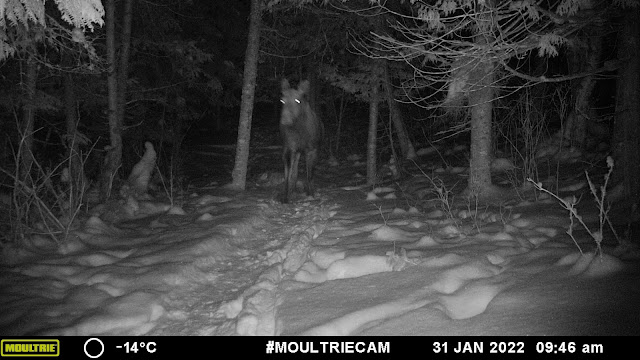 |
| Time stamp is incorrect. The hour was actually about 6:30 a.m. |
This cow moose was just passing through a couple days ago. She had followed the ridge behind our place until she came upon one of my trails, then followed it right to our house which is just out of sight in this photo. She then retraced her steps a bit and took a new bearing to the north. I would bet she then turned east again, crossed our road and went into the bush on the other side. Moose are very purposeful in their movements and when they come by here they seem to have some place in mind in the far distance.
This is actually the second moose I captured on a trail camera this fall-winter. The other was a bull who came by in September, also heading east.
Does seeing two moose in a single year mean they are coming back? Hard to say but I hope so.

 |
| I girdled these trees extensively two years ago. They still are not ready to cut down. |
I know what the trees look like on the stump: vertical, no needles, bark split or missing in patches. When the trees are cut down the wood inside is white, dry as a bone and light in weight. This wood will ignite easily, makes excellent kindling, and burns about as long as birch. It does not produce as much heat as birch but it has the advantage of creating little ash. Birch makes a bunch and it is always loaded with clinkers (charcoal) as well.
Not every dead balsam passes the grade. If the bark is not split the tree will likely be rotten and wet inside. There can be a good firewood tree standing right next to a poor one. I have been trying to purposely kill some trees to see if I can get a handle on what is going on. Is it the length of time the tree stands dead?
I girdled trees in two different areas in case location had something to do with it. In one place my girdled trees blew over in the wind well before the needles had fallen off. They are still standing in the other spot but even after two years, there are still needles on them. It looks like it will take at least another two years.
My guess about why firewood that died on the stump is so much better than green balsam cut and dried is that something chemically happens to the tree as it dies. Maybe it stores more sugar. It might also allow the wood to become drier. I just don't know.
The good news, in a way, is that lots of our balsam trees are dying. It is not budworm that is killing them this time (that happens about every 40 years); that's easy to see. The ends of the branches will be denuded of needles. Our trees have all their needles.
I suspect they are simply dying from the drier and hotter summers we are now getting due to climate change. Birch trees are dying too.
The problem seems to only affect the adult trees. Saplings are still nice and green.
So, we should have a lot of balsam firewood in our future.


DJ - the quibell detour is open to passenger traffic. We arrived in Red Lake today via the 647 (quibell) > 609 > 105.
Matt
May 21, 2022 at 11:56 PM
Red Lake Municipality has a link to the Hwy 601 map detour that goes north from Dryden and follows bush roads for about 40 miles. It comes out to Hwy 105 just north of Perrault Falls.
I would choose the Quibell route first. It is far shorter. It is also open only to passenger vehicles. Big trucks must use the Hwy 601 route.
I am thoroughly pissed at the lack of highway information out there. The so-called gold standard info site -- Ontario 511 -- would have us believe that there has been a vehicle blocking the Quibell route for the past four days. What utter nonsense! Obviously a tow vehicle would have removed such an obstacle long ago. It also reports highways closed to traffic when cars are getting through.
CBC radio and tv -- the nation's broadcaster -- has said nothing about flooded roads and highways in Northwestern Ontario.
We are left to scrounge bits of information from here and there on the web.
Thank you, Matt. Your comment was more important to the thousands of people coming and going from Red Lake than all of the rest of the web and media.
One of the more helpful news websites has been DrydenNow. It usually has a highway update. Pay close attention to whether a road is closed to all traffic, closed to truck traffic, closed to one lane, etc., and then make your decision.