Sunday, December 31, 2017

Predatory songbird northern shrike visits

Northern shrike is about the size of a whiskyjack or Canada Jay

They are known to store their catch by impaling it on thorns
I see a couple of northern shrikes every year but this is the first that I have ever photographed. It had killed -- or found-- a pine grosbeak right next to our sunroom yesterday. I say "found" because a grosbeak had beaned itself on the glass windows and had been sitting on the snow earlier. I thought it had recovered and left when a couple of hours later I spotted the shrike on the snow with feathers flying all around. Although the grosbeak must weigh about two-thirds as much as the shrike, the shrike flew off with it in its talons.
Shrikes eat small birds, usually, as well as mice. I have seen them try to catch chickadees at the feeder but never succeed. Chickadees are absolute acrobats and when caught out in the open simply fly in a tight spiral. The shrikes are pretty darn good aerialists themselves but can't quite turn as sharp a corner. The pair of birds fly around and around but the spiral pattern continually moves toward a conifer, like a balsam fir. Once the cover is reached the chickadee disappears and the shrike gives up.
Shrikes are called predatory songbirds. Why they simply aren't known as tiny hawks I'm not sure.

Friday, December 29, 2017

Let's not be like the buffalo hunters

We have reached a fork in the trail
It has been decades in coming but we are finally at the brink of a new era -- turning around climate change. We have the knowledge, the tools, the technology and finally, finally, we are finding the will.
The revolution has begun with such things as ending coal-fired power stations and carbon pricing on the macro scale and roof-mounted solar panels and electric vehicles (EVs) on the personal side.
It is full steam ahead from here on. There is lots of work to do and that's exciting.
Let's start with a network of EV charging stations that is at least as large as the current one for gasoline.
Think about what is involved to install a charging station: an electrician and a special plug-in cord. Call an electrician today and you can have a charging station up and running tomorrow. It just takes awareness that there is a quantum shift taking place in our society and figuring how you can take part -- and benefit -- from that shift. And here is where individual entrepreneurs can get a jump on the competition.
Take the case of the Beaver Motel in Nipigon, of all places.
The Beaver Motel has an EV charging station! Guess what? It is one of the few EV charging stations in Northern Ontario! Everybody traveling by EV stops at the Beaver Motel. They spend the night there. It is boosting business. The Beaver Motel has an amenity that the largest motel chains in North America lack.
So good for the Beaver! It is a leader. But it also shows the opportunities waiting to be had for other businesses. Tim Horton's, where the heck are you?
When you travel across Northern Ontario, in particular, but really anywhere in Canada, there are long distances between communities. When one finally shows up just about everybody stops, uses the bathroom and gets a snack, like a cup of coffee and a donut. We also just need a break from driving. The biggest cause of accidents on our rural highways are people who just fall asleep at the wheel.
It takes 30 minutes for a fast DC charge of an EV. That is just about the perfect break time. Hit the bathroom. Grad a cup of coffee and a donut. Stretch your legs.
There's a Tim Horton's restaurant in a great many towns across Canada. They should all have EV charging stations. Ditto for McDonalds, A&W, all the chain restaurants and all the motel chains. Such places are always on the hunt for ways to attract customers. Well, here's one and it's a biggie.
How many occasions do you get to bring in extra business and save the planet at the same time? Now is the time to make a difference.
Personally, I don't want my grandkids and great grandkids asking me the question I would like to have asked my own great grandfather's generation who wantonly all-but-exterminated the largest wild animal herd ever to have walked on the planet, the buffalo.
How could you have been so stupid?

Monday, December 25, 2017

Extreme cold warning this Christmas Day

A visitor this morning to our bird feeders


 What a great day to sit inside and eat turkey! The outside air is in the -20s C and the wind is gusting up to 36 km-h making the windchill about -40 C. Just in case you don't understand Celsius temperatures, -40 C is the same thing as -40 F. In reality, however, the windchill is worse than the straight temperature.  Or to put it another way, -40 windchill feels much colder than -40 in calm conditions. Suffice it to say it is bitterly cold outside today.
Sunroom in Celsius
I think it is the cold temps that brought a red fox out to the bird feeders this morning. It is the first time we have seen a fox this winter. He wasn't interested in the seed, of course, but rather the other creatures that come to eat the seed, especially mice. I was disappointed that he didn't wait to pick off some of the ornery red squirrels. They are probably just not worth the effort.
Meanwhile, this is probably as good a test for our unheated sunroom as we are going to get. As the thermometer photos show, the solar gain on a sunny day like this is considerable, no matter the
And in Fahrenheit
cold outside.
The inside temperature would even have improved from what is shown if only it wasn't so windy. The wind is whipping the snow up into the sky which clouds things up a bit.

Wind is whipping snow up into the sky
I'm still working on the inside of the sunroom
Conditions up at Red Lake are even colder. They are experiencing a -44 C windchill. Red Lake has gotten more snow than down here in Nolalu. You can see this for yourself in the following photograph, sent to us by Red Lake Marine's Sherry McCoy.
Scene along Hwy 105. Sherry McCoy photo

Sunday, December 24, 2017

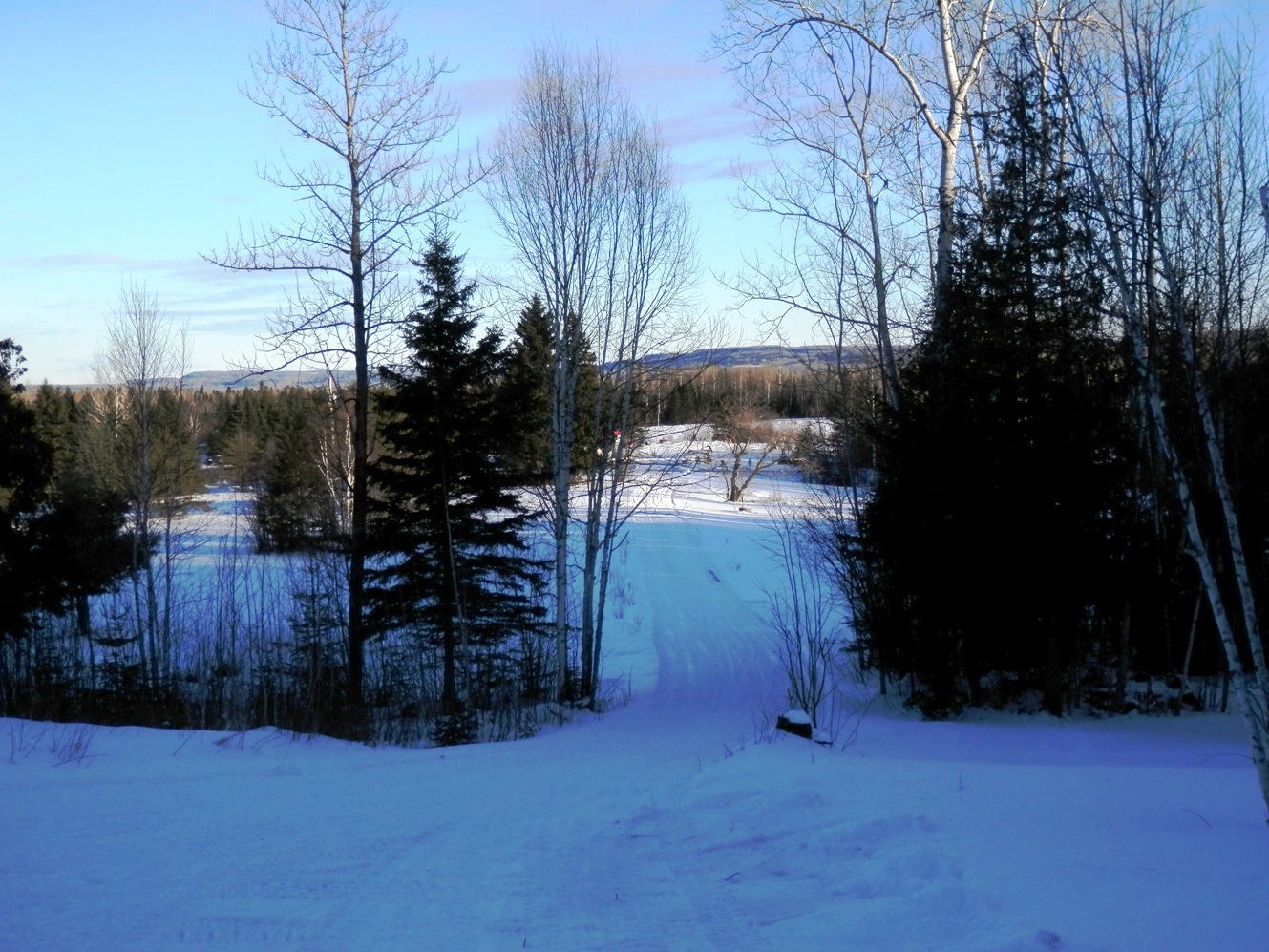
It is a 'blue' Christmas in Nolalu

After a long stretch of cloudy weather, it looks like we are finally going to get some clear-and-cold days. I love such weather because it showcases our beautiful snow. The scene of our driveway, above, shows how the snow turns to blue in the evening. It is often pink in the morning. And when the temperature is absolutely snappy, like what Christmas and Boxing Day are expected to be, the snow turns into fields of diamonds, sparkling so brilliantly you need to wear sunglasses.
Merry Christmas!

Tuesday, December 12, 2017

Nice and toasty without any fuel

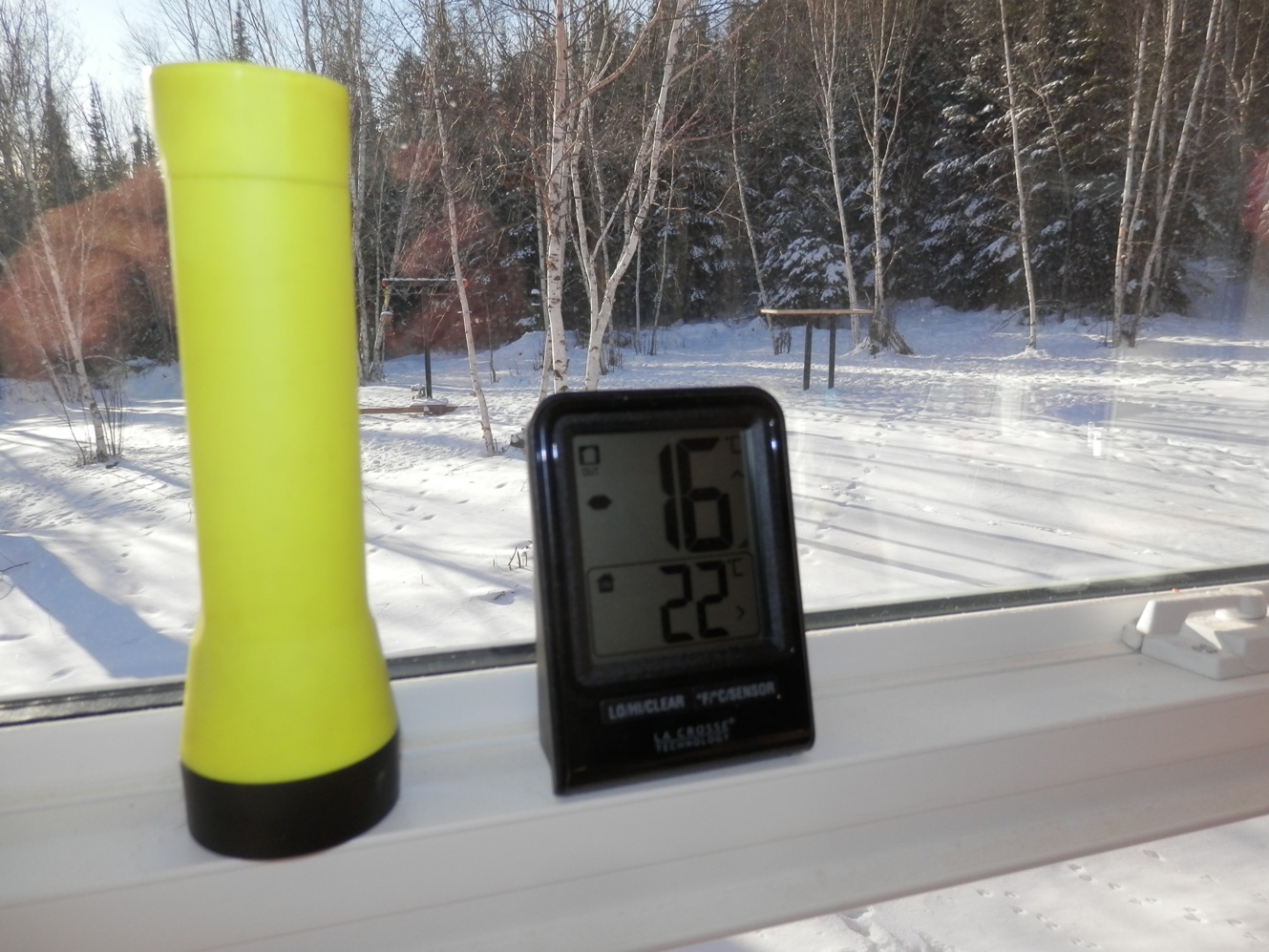
Upper number is temperature outside, bottom is temperature inside
The sun had only been up for two hours and already it warmed our sunroom to a comfy 22 C despite it being -16 C outdoors this morning.
The sunroom started out the morning at -1 C while the outside air was -20 C. It gets a dribble of heat from our furnace but for all intents and purposes is unheated. A full basement beneath that connects to our main basement provides a smidgen of warmth also.
The point of the photo is just to illustrate that we can get heat absolutely free from the sun and not continue to add to the pockets of the one per cent that own the fossil fuel industry and who have more wealth than the other 99 per cent of us.
That's my solar flashlight in the window, charging up. I haven't bought a flashlight battery in years now.

Wednesday, December 6, 2017

Great book about Ontario's outdoors

If you like doing things outdoors than you are automatically interested in the weather because it influences everything you do.
I picked up this copy of Weather of Ontario by Phil Chadwick and Bill Hume last week and I absolutely recommend it. It is chock full of details about Ontario's weather systems, records and changing climate.
This is a Lone Pine book and is available in all types of retail outlets, including places like Canadian Tire. I got my copy at Famous Bobbys tackle shop in Vermilion Bay.
This would make a great stocking stuffer for anyone who lives or vacations in Ontario. There are hours of fascinating reading here.
Our tiny village of Nolalu even made the book! It holds the record for the most snow in a 24-hour period at 101.6 centimeters, set on March 24, 1975.
And nearby Thunder Bay also gets a superlative. It has the sunniest winters in the province.
No wonder we love to live here.


Tuesday, December 5, 2017

Northwest Ontario in midst of wintry blast

Snow is pasted to my trail camera lens
Highways, schools and businesses were closed and the power was in and out most of the day for many places in Northwestern Ontario today. A cold front moving down from the Arctic collided with a balmy warm front that had settled over the Northwest for the last couple of weeks. It rained on Monday but then the temperature plummeted overnight and the rain turned to snow. We only got a couple of inches here in Nolalu but the big problem was very high winds, gusting up to 70 km-h. The storm has largely moved east now and the temperature is supposed to go into the cellar. Daytime highs a few days from now are expected to be just a miserly -15 C.

Monday, December 4, 2017

Here is the ultimate weather website

The precipitation picture at 3 p.m. today for NW Ontario, N. Minn. and N. Wis.
I have found this world-view website to offer the very best look at what is happening with the weather.
The screenshot of Ventusky above shows what is happening right now in our region. You can get a similar view of any other place in the world.
It not only shows precipitation maps but also ones for temperature, wind, wave height, snow depth and a bunch of other things.
You can zoom in or out and move around anywhere in the world.
Ventusky. Check it out.


Saturday, December 2, 2017

Good morning, Mr. Lynx

How cool is this!
This may be the first lynx ever photographed on one of my trail cams. It was taken this morning. I have photographed and filmed lynx with a standard camera in the past but not with a trail camera. Part of the reason for that is that these cats don't usually follow trails. Rather, they hunt along edges of brush where their prey, snowshoe hares, like to live.
This is the third lynx I have seen this early winter. The other two I saw on the road which, frankly, is the most likely place to see one.
There is a great lynx story this month in our Nolalu newsletter, the Grassroots, from local writer Leo Hunnako. It recalls an incident a year ago where a local man was sitting in a ground blind while hunting deer. He was sitting as motionless as possible when he felt what appeared to be an insect on his neck. Turning his head slowly so as not to scare any deer that happened to be looking, he came face-to-face with a lynx. It had been the lynx's whiskers brushing against his neck that he mistook for bugs.
He kept his cool and the lynx eventually left.
Lynx are as silent as owls. They have fluffy feet that keep them on top of the snow in winter but which also don't make any noise, even on leaves.
Like all cats, they are curious and it can be unnerving to have them walk right up to you although the case above would be the ultimate test.

Friday, December 1, 2017

Window prism tape stops bird strikes

Birds avoid the sparkling tape
We worry about all the windows in our new sunroom killing the songbirds at our bird feeders not too far away. So this fall we bought a roll of iridescent, reflective prism tape from Lee Valley, a Canadian mostly-mail order, tool company.
 We hung a strip of the tape on a thread in the center of the largest windows on each side of the sunroom. The tapes twist around on their threads creating sparkling colours. I am impressed at how well this has worked. I've only found a single dead bird and it might not even have hit the sunroom windows but possibly one in the main house.

Thursday, November 30, 2017

Squirrel hawk wanted

Looking for raptors that will work for food

The arboreal rodents are mostly thwarted by feeders set up on sewer pipe
For at least a decade we used a bird feeder made by one of our grandsons, Raven. It was a platform feeder with a roof that stood on 2x4 legs a couple of feet off the ground. It worked great and was a hit with the whitetail deer as well. But then the Mongol hordes of squirrels arrived. They could clean out the feeder in just an hour or two.
So two years ago I made a simple platform set up four feet on three-inch plastic sewer pipe legs. Sure enough, it was too high for the red squirrels to jump up to and too slippery for them to climb. It worked like a charm until this year when one squirrel solved the puzzle. He would jump up to one pipe and upon striking it would spring off to one of the other three pipes and so on until he reached the wooden platform. He sort of ricocheted his way to the top. I couldn't believe it. So I sprayed the legs with WD40 and that has worked, so far.
Meanwhile the remainder of the dozen or so squirrels were cleaning out the small hanging feeders in the trees. So this year I made a single-pipe, T-shaped sewer pipe stand for these feeders as well. So far, so good.
I wouldn't begrudge the squirrels some sunflower seeds if they were nice little animals. The deer, for instance were pleasant, respectful visitors. But the red squirrels are vicious, evil, ill-tempered idiots. Nobody likes them. They don't even like each other.
Squirrel hawks, apply in bird to the above location. You can start work immediately.

Wednesday, November 29, 2017

The parka I've looked for all my life


Seine River Parka
My trail cam was the photographer for my fashion shoot this morning. I'm wearing the most unique garment I've ever seen. It is a wool felt parka made by Seine River Shepherds in eastern Manitoba.
My goodness but if this isn't the coat I've had in my mind's eye forever!
I picked it up at Egli's Farm in Minnitaki (just west of Dryden, ON) this fall.
It is wool felt so it is denser than a knitted garment and therefore more closed to the wind while still being totally breathable.
It is also generously cut, something just not found in any other parka out there. This lets a person add layers underneath without making the coat tight and therefore cold.
It also has a unique cut to the bottom. Rather than being sewn evenly across the hem it has flaps for-and-aft that make it easier to sit down. I'm just guessing that Seine River made this for horseback riding but it works just as well for sitting down in the truck.
The parka had an internal wool belt that I found was in the wrong position, for me at least. It tied right around the middle of my gut. So I pulled it out and tie it around the outside at my waist. This is not only more comfortable but also warmer since it seals the parka at the bottom of the torso. I'm toying with the idea of using a Metis sash for this. It would certainly be more colourful. Etchiboy is a great Canadian and indigenous people's website for authentic voyageur-style sashes. I will probably stick with the wool belt because it is more functional for me although the wide sashes of the voyageurs were also made for a reason: they were hernia belts. These small, wiry men of both native-Scottish and native-French descent were legendary for the incredible loads they carried from the interior of Canada to and from fur-trading posts at Fort William (now Thunder Bay) and Montreal.
I love the fact that my new parka is made locally from renewable materials. Buying local not only helps out your local economy but also is a key part of living sustainably.

Tuesday, November 28, 2017

Whitetails everywhere are in the rut

What a beautiful scene, right here at our home.

Whether you live in Northern Ontario or Wisconsin or even South Carolina, it seems that whitetail deer all start their mating season at the same time, in early November. That would suggest that it is the photoperiod and not the temperature that is responsible.
Here in Northwestern Ontario the bucks are all on the move, looking for does in heat. It has always seemed to me that weather has little effect on the deer behaviour. Despite what others maintain, I have never been convinced that an impending storm, etc., makes any difference. Deer probably don't move during the storm but that's about it.
Whitetails are prolific breeders, in contrast to moose which are absolutely terrible at it. It is a rare thing to find an unbred doe whereas lone cow moose are pretty common.

Sunday, November 12, 2017

Why haven't lilac bushes lost their leaves?

It's winter but these ornamental shrubs still have green leaves
Lilac bushes here in the Thunder Bay area of Northwestern Ontario never lost their leaves before winter set in this year. It's the first time I have seen this and I can only speculate that the hot days we received in late September somehow tricked the bushes into thinking there was still a lot of summer left.
Does anybody out there know the reason? If so, leave your comments.
Lilacs, of course, are not a native species. They originally came from Asia but they are the most widely planted shrub in Canada, according to my tree books.
They are exceedingly hardy and can endure extreme temperatures.
I wonder if the fact they kept their leaves will impact the blossoms next spring?

Friday, November 10, 2017

It's baaack! Old-time winter weather

Our home in Nolalu as seen today, Nov. 10
The temperature this morning was -20 C here at our home in Nolalu, ON, which is 50 kilometers (30 miles) southwest of Thunder Bay. That is the coldest it has been this early winter and reminds me of what Novembers used to be like before climate change.
I especially remember one Remembrance Day (Nov. 11) in the mid-1980s. It was -30C. The day sticks in my mind because I shot a big buck whitetail that morning. With the help of a friend I brought it back to our house and hung the deer in the garage. The deer was enormous and had 13 points. I wanted Brenda and the kids to see it before I cut it up and so waited until they all got home after school.
By 4 p.m. I tried to butcher the deer and found it was frozen rock solid. I ended up taking it into our wood-fired sauna to thaw it.
In those days we still lived in the original house made on our property. It had been built about 75 years earlier and started out as a 16x20 squared-timber homestead cabin. The woodstove was our sole source of heat. I followed the previous owners advice and would fill the woodshed attached to the garage with wood each summer. The shed held about eight cords. By the end of each November I would start to panic because we had already consumed one-third of our wood supply. That happened not only because the temperature was so cold but also because November is a notoriously cloudy month so there was little solar gain in the daytime. A further complication was a lack of snow for which to bank the house. I would often scrape the ground for hundreds of feet to get something to pile against the building and block the wind and cold from underneath.
December always brought deeper snow and although the daylight was even shorter, there were more clear days. We barely had to fill the stove if the sun was shining through the windows.

Saturday, October 14, 2017

Turning over a new leaf

I'm starting life anew after retiring from Bow Narrows Camp and so it seems like a great time to start a new blog, this one just about life in the great outdoors here in Northwestern Ontario.

Reduced version of blog is back

 Thanks, everyone, for your advocacy. This pared-down version of the blog is what I am comfortable leaving public in today's situation. ...