Thursday, June 1, 2023
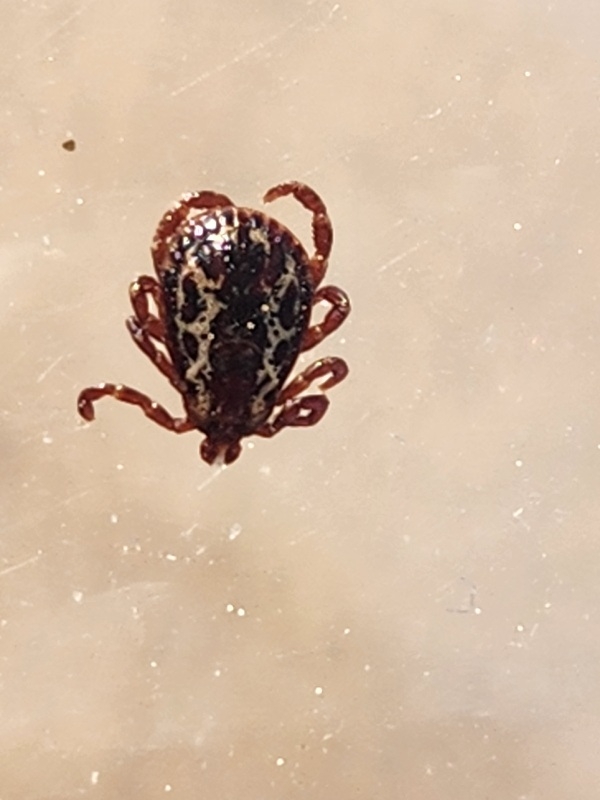
How did all the ticks get here?
In just a couple of years wood ticks have moved into this area. Whitetail deer are usually thought to be the transportation vehicles but that can't be the case here. Deer are still very rare.

Saturday, May 27, 2023
Cell phone now works at cabin
It just took a cell booster and a 50-foot antenna.
The weather is hot and dry with low humidity which makes the heat tolerable but increases the forest fire danger. No local fires so far.
Thursday, May 18, 2023
One opening weekend posed a dilemma
As the opening weekend for fishing season approaches, Brenda and I can't help but think back to all the ones we went through as owners -- and before that -- workers, at Bow Narrows Camp. It was always a thrilling, exhausting, but totally memorable time.
The timing of ice-out with the season opener was what set the stage. The opener is a moveable feast. It is the third Saturday in May. So, it can be as early as May 15 and as late as May 21. Early openers always meant we were flirting with being still iced-in when the guests arrived.
Sometimes we needed to fly from the Chukuni River in town over the lake ice to the open narrows in front of camp. Even in those situations we could usually get the staff into camp a few days ahead of the guests to get things prepared but at least once we all went on the same day. Dad, Brenda and I were the staff at that time.
You can imagine the chaos: water is not yet running to the cabins, boats are not in the water, motors are still in the storage shed, etc. The first priority was to get everybody out fishing. The next was to connect propane tanks so they could use their kitchen stoves. By that point it was dark. We gave everybody plastic pails to get water from the lake.
The next day we slowly started getting the water system going. The problem was the main underground water line was still frozen in many places. This meant jury-rigging over-the top lines that would suffice until the ground thawed, something that might not happen for weeks. It took days but eventually everyone had running water.
We had immediately tried to schedule a supply flight but were told all the fly-in camps were in a pickle. The lakes were opening up day by day and as soon as they did, all the planes were booked to fly-in those guests who had been stuck in hotels. Our supply trip would just have to wait.
Days went by and we were almost totally out of gas for the outboards. And worse, lots of the guests were forced to leave most of their beer supply in their vehicles when they had flown in. There just had been no room. The situation was becoming critical.
Finally, about mid-week we got a call from the airlines that they could get one Cessna 185 into our place. It was the smallest of the aircraft and could carry about 900 pounds. What did we want them to bring?
We held a general meeting of the guests. Gas or beer or some of both? After a lot of discussion about the merits, they agreed -- fill the plane with beer. They could fish off the dock.
And that is what happened.
Tuesday, May 16, 2023
Limitations to the blog while at cabin
If we can get the cell system working at the cabin this summer, please note that while I can post text and photos, I cannot detect and approve comments. If you make any comments they will be answered and approved whenever I return to Nolalu. This is just a limitation of blogging by cell phone.
We hope to leave for Red Lake in a few days now.
Update to World's Greatest Pike Lure
If you want to contact lure maker Dwayne Kotala, here is his e-mail address:
dwaynekotala@gmail.com
First flower of spring near death scene
 |
| I can't identify this flower. Can you? Please leave comment. |
The deep spring snows that we seem to be getting all the time now are to blame, I would think. April is now a month to dread. It brings several storms of snows that might each leave a foot of heavy slush. For animals that barely made it through the long winter, it's the final straw.
Just a few yards from the death scenes I found these tiny flowers, the first of the season here. They are about three inches high, are purplish in colour, have hairy stems and no obvious leaves. They are a mystery to me. I cannot find them in any of my books.
What a fitting example of nature: death and life born anew.
Saturday, May 13, 2023
World's Greatest Northern Pike Lure

 |
| Kotala pike jerk bait |
Now about the lure: it is a handmade wooden lure made by my neighbour Dwayne Kotala. He makes them in various lengths. The one above is about seven inches long. I have also used nine-inch models and five-inchers. This floating lure has internal stainless steel weights to give it the right attitude in the water.
It can be fished using two techniques. The best, in my experience, is to cast it out, pull it forward a few feet either by fast reeling or by just pulling back on the rod. The lure will dive a few feet while making exaggerated wobbles. I then let the lure float back to the top. It makes smaller wobbles as it floats to the surface.
This action looks exactly like a mortally wounded fish.
The other technique is to just reel it steadily back to the boat. It will wobble all the way and will run about six feet deep.
I have never seen another lure catch so many really big northern pike. In some places and times on Red Lake, it seems impossible to get it back to the boat without it being nailed by pike that range 36-46 inches in length. Small pike seem to leave it alone.
There is one problem with the lure, however. Fish always engulf the entire thing and it is very difficult to extract from their toothy maws. My solution is to replace the two small treble hooks with very large single siwash hooks that face forward. This doesn't hurt the lure's action.
You can reach Dwayne by email: dwaynekotala@gmail.com
I would imagine the Kotala lure would be equally deadly for musky but I can't be sure since there are so few in Red Lake.
I recommend you use a baitcasting reel on a fairly stiff rod with this lure. Keep the reel filled with a 30-pound braided like FireLine or SpiderWire.
Best places to fish it are entrances to narrows, backs of bays, below rapids where walleye congregate.
It is especially effective in the evening when there is calm water.
Friday, May 12, 2023
Red Lake ice-out was May 10

At least, according to the Bow Narrows blog. I have not heard from anyone directly.
What a nice break this spring has been in Red Lake compared to last year.
Sharpen those hooks! Fishing season is just a week away!
There are still bits of snow here in Nolalu even though we've had four days with summer-like temperatures.
Thursday, April 27, 2023
It's time to fish or cut bait

Metaphorically speaking, that is. I mean, don't go fishing yet because the season doesn't open until May 20. Nothing stopping you from cutting bait at this time though.
What I'm saying is, it's time to gaze into the crystal ball, throw a dart at the board, play a hunch, take a risk, stick your neck out and pick a date for ice-out in Red Lake.
So, here's my prediction: May 13.
We got a clear image from space today on Worldview as you can see above. It shows no snow on the ground from Duluth all the way north to Northern Manitoba. You can find Red Lake by finding the larger zig-zag lake about three-quarters up. That's Lac Seul. Its northwest end points to Pakwash Lake. To its northwest is Gullrock Lake and to its northwest is Red Lake, the horizontal lake with the hammerhead on the west end partly obscured by cloud. Trout Lake is the large roundish lake to the east of Red Lake.
Incidentally, Nolalu is well off this image to the northeast. We still have a foot of snow in the bush here and several inches out in the open. Most of this came in two dumps during the past two weeks.
If you want to load the above image into your computer so that you can enlarge it for better resolution, click here.
Friday, April 21, 2023
Getting ready for solar system at cabin
 |
Maier Hardware in Thunder Bay will be our equipment provider. This is the same company that supplied us with all our electrical needs when we built our home in Nolalu, 40 years ago. Maier is a long-time supplier of solar equipment in the region and has extensive knowledge and experience about what is needed for a remote installation like ours.
There may be cheaper suppliers; however, my experience is that I have never minded paying for quality and always regret buying junk.
We began by listing all of our electrical requirements to Maier's Dave Green. They were minimal. A cell-phone booster, the occasional use of a kitchen mixer, places for people to plug-in their computers and phones, CPAP machines for our friends and relatives. The biggest electrical consumer will be a washing machine but that won't be used every day and since we will dry our clothes on the clothesline, means we will be washing only on sunny days when solar power is plentiful.
At 3,000 watts our solar system is about as small as you can get without just buying some solar panels and charge controllers from Canadian Tire.
We already have a solar fridge and water pump. They are stand-alone units and won't be part of the bigger system. However, eventually the fridge will need replacing and when that time comes the new system is already designed to handle a standard Energy Star-rated home unit.
I can see it will take us awhile to get our heads around how to best use the solar system. Dave had asked if we were going to have a microwave or coffee maker. Of course not, we said, those things use too much electricity. Well, we still can have such conveniences, he pointed out. You just need to use them differently. For instance, rather than heating up leftover pizza in the propane stove oven -- something that might take 30 minutes and produce unwanted cabin heat in the summer -- we can pop it in the microwave for just a minute. A coffeemaker takes eight minutes to brew a pot. At that point we can pour the coffee into an insulated carafe and turn off the electricity-draining warming plate.
Thanks to LED technology, cabin lights are not even an issue. They take practically no juice.
We already have a water-treatment system that we have been using the last couple of years in the dockhouse. This uses filters and a UV light. We will move this to the big cabin. We filter just our drinking water which is kept in the five-gallon blue jugs. It takes about 10 minutes to fill two or three of these. For Brenda and me, that's enough for more than a week.
One of the things we have figured into the equation are electric fans for every person, especially for sleeping. These too don't use much power.
Our system is designed to produce the electricity we need most of the time but not in all circumstances. That would take a far more costly installation. In the fall when daylight is short or for extended cloudy periods, we will likely need to start the generator at times. This will both provide immediate power to the cabin but also will charge the solar system batteries in about four hours. The system will then be good for another few days without need of the generator. If sunny weather returns, we may not need the generator at all, even in the fall.
We can always use the generator for large power needs such as extended periods of using the air compressor and multiple power tools. Those things will run on the cabin system too, just not all day. The cabin system will easily recharge tool batteries and we have also purchased a cordless lawn mower.
The point is to drastically reduce our use of propane and gasoline -- fossil fuels -- and to preserve the peace and quiet of being in a wilderness area.
Monday, April 17, 2023
Watch Gussie catch walleye on plastics
Want to take a lot of the aggravation out of fishing for walleye this summer? You know what I'm talking about: dead minnows, worms and leeches, deep-hooked fish that die, etc. Walleye fishing would be so much more pleasant if you took live bait out of the equation.
Here's how to do it. Watch BassMaster Classic winner Gussie (Jeff Gustafson of Kenora) catch walleye and bass on Lake of the Woods last summer.
And here's something that should ease Red Lake anglers worries about smallmouth bass becoming established in Red Lake: Gussie catches both fish in the same place.
Thursday, April 13, 2023
Big forest fires could change ice-out times

As I looked at the area with no snow on the Windy app and then the area that burned in forest fires in 2021 as seen on the Worldview app, I realized they are one and the same. Then came the epiphany: the reason there is no snow on the ground from Red Lake west to Lake Winnipeg is the same reason there is no snow in central Manitoba -- there are no longer trees to create shade that slows down the spring melt.

It takes a little practice to interpret the Worldview satellite photo but that smooth, dun-coloured area west of Red Lake is all a burn. Many of the places that burned in 2021 had also burned in 2018 and 2016 and earlier.
In reading 2022 blogs of canoeists who paddled Woodland Caribou Provincial Park -- the area west of Red Lake -- they tell how places with 3-5-foot new growth trees from those earlier fires burned again in 2021. Even the standing dead tree trunks from those earlier fires burned. There wasn't even enough wood to make a campfire. In lots of places even the soil burned leaving nothing but exposed bedrock.
As I speculated in this blog at the fall of 2021, I wonder if the treeless prairie is now extending all the way to Red Lake?
Woodland Caribou is the eastern half of the gigantic wilderness canoeing area west of Red Lake. The Manitoba western side is called Atikaki Provincial Park. Together they encompass millions of acres and just about all of it has burned, mostly in 2021.
Forests have an impact on weather systems. They slow the wind and retain moisture. Now that there is mostly wide open space between Red Lake and the Prairies, I think we can expect some big changes.
Trout Lake angler George Miller uses the end of snow on the ground as a start to the countdown of when ice-out will occur on Trout Lake. It happens roughly 30 days later.
This makes sense. Once the snow is gone the dark ground heats rapidly and makes the whole area warmer. So early no-snow dates caused by lack of trees should lead to earlier ice-outs.
Wednesday, April 12, 2023
Oh baby! Summer-like temps ruining ice
Check out this photo of Howey Bay in Red Lake, yesterday, taken by Red Lake Marine's Sherry McCoy.

All the snow has melted off the lake ice.
Then check out the snow cover layer on Windy.com website and app. It shows Red Lake and areas all the way west to Lake Winnipeg being barren of snow.
I'm moving my ice-out date back to May 8.

And if you are wondering where the snow-line is in North America, look at this clear view from NASA Worldview today.

Friday, April 7, 2023
April 1-7 was awful, ice-out now May 15
The first week of April could easily have been the first week of March, weather-wise. There was zero melting and a big dump of snow. So, I have adjusted my ice-out slide rule accordingly. At this point, I would say it will be a week late or May 15.
Wednesday, April 5, 2023
Big fishing news: record trout, Smeltinator
Just in case you haven't been plugged in, a lady from Red Lake caught a record lake trout through the ice this winter, apparently at Trout Lake.
At 58 inches and 57 pounds, it was certainly an ice fishing record in Ontario.
Here's a link to the CBC news story.
And in other big news, a professional angler from Kenora won the Bassmaster Classic, the first Canadian to ever do so. Here's a link.
Red Lake anglers should take note that Jeff Gustafson, aka Gussie, won the tourney using his own Smeltinator jig.
All fish, including walleye, in Red Lake key-in on smelt. There's a tip for ya!
Monday, April 3, 2023
How did Skookum Bay get its name?
In the old days when my dad, Don Baughman, and step-mom, Anne, operated Bow Narrows Camps they would travel to Red Lake from Mentor, Ohio, the first week of May and settle into the Red Lake Inn while they waited for breakup.
With nothing much to do, they would drive around and look at the lake ice from various locations. It was during these little sightseeing trips that dad made a discovery. Every year the ice went out in Howey Bay seven days after it disappeared from Skookum Bay.
Skookum Bay is a long, narrow, creek-like bay that you cross on a small bridge on Forestry Road.
When I came back to the business in 1992 I would get telephone reports from Dad as he watched the bay. Our home in Nolalu, near Thunder Bay, is just a six-hour drive from Red Lake so there was no point in me waiting at the Inn with Dad and Anne.
Finally, Dad would say the ice was gone in Skookum and so I should arrive in Red Lake seven days later. I would do so and would find Dad and Bob Uhrina from Red Lake Marine launching the Banana Split -- the camp's large trip boat. The ice was breaking and either we could go directly to camp that day or wait until the next to give the big ice pans a chance to blow against one shore and leave a clear passage on the other.
After Dad passed, I would try to get reports from Red Lake residents on how Skookum Bay was melting. I even phoned people who worked at the Forestry Point and had to cross the bridge every day. None ever paid any attention to the bay and its ice. That's how I came up with my alternative method of calculating ice-out which I have documented here on the blog.
I've always wondered about how Skookum Bay got its name. I have read enough Jack London novels and Robert Service poems to recognize that Skookum is a west coast name or at least a far northwest name. There were lots of Skookum references in the Klondike gold rush. That rush took place in 1896 and was the second largest in history. The biggest was the San Francisco gold rush of 1849. The Red Lake rush in 1926 was the third-largest.
Could someone from the Klondike gold rush with a name like Skookum Joe have lived on the bay in Red Lake? It's possible.
But what does Skookum mean anyway? I found an interesting website called Indigenous Corporate Training Inc. that tells how First Nations had a special trading language called Chinook Jargon which let them do business with each other, especially the west coast nations. Non-indigenous people came to use this language as well and some of those terms are still used by us. Anyway, one of those Chinook jargon words is Skookum meaning big or powerful.
Skookum Bay is neither which makes me wonder if someone like "Skookum Joe" might have lived there. Anybody know?
Thursday, March 30, 2023
How to calculate Trout Lake's ice-out
Long-time Trout Lake fisherman George Miller provided his technique for figuring ice-out on this big lake northeast of Red Lake. George is always an opening week angler at Booi's Fly-In Lodge.
George had just read on the blog my system for predicting Red Lake's break-up and writes:
"We've been going to Booi's for opener for over 20 years
and as you can imagine watching the ice has become a part of that.
After spending far too much time over the years doing all sorts of
statistical analysis of far too much data, this spring I finally arrived
on an approach that appears to work very well and is - nearly identical
to what you suggested.
It
appears the only (and not significant) difference for me is the use of
the date snow is gone as the start date of keeping track of
temperature. I decided the snow insulates the ice from temp and sun so
the day it was gone would be a good trigger date. I then keep a running
average daily high temp. The model I came up with for ice out around the
island is 1.5 days longer than 'normal' for every degree below average
high, and 2.6 days faster for every degree above normal; average ice out
is 27 days after snow is gone. The entire lake typically goes out
completely a week after the island area is open."
I e-mailed George back and wondered how he knows when the snow is gone.
It's
looking like another late ice out this year so far unfortunately. The
average is roughly a month after the snow is gone that things start to
open up. With (possibly quite a bit) more snow on the way and no sign
of melting in the 2 week forecast, it could be a while unless a heat
wave comes in."
"We're down in Rochester so I have to rely on what I
can find on the Internet. Red Lake used to have a remote sensing
station that provided snow depth but for whatever reason that stopped a
few years ago. Now I use the station in Ear Falls; at ~30 miles away it
seems like the snow cover should be the same. This is a link to it
which has a wealth of historical data also.
One of my favorite tools to see how the ice is doing is from NASA. Take a look at this link:
The
layer under Albedo listed on the left hand sidebar is like magic. It
lets you see through the clouds and it seems to give a sense of the
thickness of the ice. The other layer that I have turned on is the
Corrected Reflectance (True Color) which is a clear enough image to get a
good idea of ice when it isn't cloudy. With this you can look at past
years and see when the ice has gone out too. Great way of monitoring
remote lakes! When the color is gone under the Albedo layer it seems
like the ice is gone a day or so later.
I found
ice out history for Howey Bay at this link and it is consistently
within a day or so of when I have the ice going out around the island on
Trout. https://hwy105.ca/wp/wp-content/uploads/2017/12/2016-ice-out-history.pdf The entire lake is almost always fully ice free about a week after the island area is open.
Thank you, George, and good luck fishing this season!
And while we are on the subject of watching the weather, I like the Windy.com app. It not only has a great radar picture and graphic, it also has links to live weather cams all over North America, including a bunch in Northwestern Ontario. And it has a layer that shows snow on the ground. I'll try to link to that here.
Here's a screenshot below from today.

Monday, March 27, 2023
See Red Lake's forest fires July 17, 2021

In this photo you can see the town of Red Lake labelled about mid-image, slightly to the right. Look at all the smoke plumes streaming from left to right, that is, west to east!
Monday, March 20, 2023
Lighten up! Spring is here!
 |
| Sunrise on March 20, 2023, the Vernal Equinox, in Nolalu, Ontario |
Our driveway in the photo above is looking directly east. I always think the sun on the equinox should rise directly in line but it's always a shade to the north. Why? According to a writer at Space.com there are a couple of reasons but perhaps the largest is the lens effect of the atmosphere. This makes the sunrise look like it is farther north than it really is.
See the hills in the distance? These are part of the Nor'Wester Mountains which are much higher nearer Thunder Bay. Here's an interesting fact. The other end of this mountain range (hills really) is Niagara Falls. Down there it is called the Niagara Escarpment.
And here's another surprising tidbit: the escarpment also goes under Lake Huron. A story in this month's Canadian Geographic is about how researchers have discovered man-made blinds made of rock along the underwater ridge. These were used by First Nations people 9,000 years ago when there was still a glacier from Northeastern Ontario to Greenland.
The escarpment in those days made a land bridge between two enormous lakes and the caribou used it during seasonal migrations.
Using remote underwater vehicles the researchers were also able to sample sediments along the ridge and found obsidian tool flakes left behind by those ancient hunters. The obsidian came from Oregon! The trading that took place back then and the transportation routes they had are just incredible.
Eventually, of course, the glacier melted all the way to Greenland, raising the water level in the Great Lakes and submerging the caribou corridor.
Monday, February 27, 2023
As Dr. Scholls said, "I stand corrected."

Maybe Dr. Scholls never said this but I bet he wished he had. For the better part of a century Dr. Scholls arch supports were about the only relief people with flat feet and other foot and leg alignment problems could find. Then came the Baby Boomers. As this balloon in the population demographic got older things like custom orthotics became all the rage. Boomers had money and didn't bat an eyelash at spending 10 times what Dr. Scholls arch supports cost. Boomers ruled the world and that brings me to the point of this article.
On Nov. 29 I had a posting entitled Species Dwindling Except the One that Needs It where I linked the demise of thousands of species on the planet to the increase in human population. That part of my essay is accurate. It was the reason I gave for why the population was swelling that was wrong or at least outdated.
I said the Boomers -- my generation -- weren't able to control our birthrate. Turns out we actually did.
The authors of Empty Planet --The Shock of Global Population Decline use statistics from every region and country to prove that the world population is going to plummet. The reason is humans are not having enough babies to sustain the status quo. And yet, as I pointed out in my blog, the world population went from three billion to eight billion in just 50 years! How can these two things be true?
Well, it turns out that while the fertility rate around the world was decreasing, the longevity rate was increasing. People are living longer. New additions to the population outnumber the people leaving the planet. Thank modern medicine, including vaccines, and the Green Revolution in agriculture for that.
The message that Canadian authors John Ibbitson and Darrell Bricker are conveying is earth-shattering. The leaders of every level of our government need to understand the implications of what they are saying. We all do.
Everything in our modern society is based on perpetual growth in population. When a municipality, for example, figures out what some new piece of infrastructure is going to cost, be it a sewer plant or a street, it assumes there will be more people to pay for it as time goes on, not fewer. Ditto for bigger things like old age pensions and national security. Everything.
The first thing we need to realize is the downsize in fertility rates is not something predicted for the future. It is happening now and in fact has been happening for a hundred years. My parents came from families of 7-10 kids. My generation had two. You need 2.1 just to keep the population stable. The .1 comes from the fact that not all women live long enough to reproduce.
With the exception of countries in Africa, almost every nation has a fertility rate less than 2.1. And even in Africa where disease, famine and political instability are the worst, the rate is plummeting and will be below 2.1 in just decades. It already is in some countries.
Just last month it was reported that China's population has started to decline for the first time ever.
The key to understanding why this is happening is the urbanization of human society, say Ibbitson and Bricker. I think many of us have heard that education, especially of women, was integral to lower birth rates. That is not wrong, say the authors, but before education becomes widespread, urbanization takes place and the whole world is rapidly becoming urban.
In cities, children are an expense, not an asset the way they might have been on the farm. Everybody has access to education and better access to medicine. Family -- clan -- tribe -- religion -- connections are not as important. Couples do what makes sense for them rather than being pressured into things.
A future with fewer people is obviously good news for the planet but it spells big trouble for how we run our societies. In the near term, like for the next 50-100 years, the countries that are going to fare the best will be the ones who take in the most immigrants.
But don't think immigrants are going to boost the fertility rate. They don't have any more kids than the natives. However, they do add to the population, the tax base, the need for consumer goods. They keep things running. And contrary to naysayers, they become the employers, not the opposite -- taking jobs from the domestic workers. Six out of 10 business start-ups in the U.S. are made by immigrants.
To hinder, or prohibit immigration -- the way Japan has done, for instance -- is economic suicide. What was the last great invention that came from Japan? The Sony Walkman. That was 50 years ago. The population is declining there and so is the economy. It's the same for lots of countries.
Guess what country is the best at bringing in immigrants? Canada! As a percentage of population Canada welcomes three times more immigrants than the U.S. which by shear numbers is still the largest.
Empty Planet notes that both the right and left misunderstand immigration. The right thinks that immigrants are taking "all the jobs" and the left thinks it is the charitable thing to do. Neither of these things is correct. It is good for business.
After I finished reading Empty Planet, I read it again, and then again. I dog-eared the pages that had important facts. The book is almost totally dog-eared. I have practically worn it out and I didn't even get it until mid-December.
I would say it is one of the three most important books I have ever read. It explains what is happening in the world and what is going to happen in the future.
Here's something to think about: since the 1950s the Boomers have done everything in record numbers. Now they are leaving the planet in the same way.
Subscribe to:
Posts (Atom)
-
 It seems to me, from what I can determine from Google's blog diagnostics, that perhaps I am blogging to only a handful of people. If s...
-
Thanks, everyone, for your advocacy. This pared-down version of the blog is what I am comfortable leaving public in today's situation. ...
-
 The flat, soft needles of a balsam fir Spruce needles are like a stiff bottle brush I often hear Boreal newcomers mistake balsams an...