Thursday, April 16, 2020

A Yankee in the Canadian Bush - Why here?


Bow Narrows Camp, 1961, was a pretty modest place

Chapter Two

Why this place?
My Dad had found it by chance. He and a friend, Milt Young, had set out in the spring of 1960 determined to be partners in a hunting and fishing lodge, either in Canada or Alaska. For years my parents had been going fishing to Eastern Ontario at the camp of my great uncle, Bill Baughman. Rainbow Lodge was on the Pickerel River, a tributary of the more famous French River that drains Lake Nipissing into Georgian Bay.
My mother, father, sister - Sandi - and I had become landed immigrants or legal residents of Ontario in 1959. I obviously had not been a planned child. Sandi was 11 years older than me and my brother, Bill, was 14 years older. In 1959 when I started Grade 1 or First Grade as they say in the States, Sandi graduated from high school in Willoughby, Ohio, and Bill graduated from Marietta University. Bill was also married to my sister-in-law, Ann, by this point and they were both enrolled in masters programs at the University of Michigan.
In a quirky turn of events, Sandi became my first teacher. Several years earlier Dad and Mom had bought Uncle Bill and Aunt Betty’s winter home in the railroad community of Pickerel River and had been using it as a summer cottage. The community of Pickerel River was where the Canadian National Railway crossed the river and was an official stop for the train. This meant it had a post office, a general store and a one-room school. Population might have been 100. The nearest highway was 10 miles upriver.
Dad had worked in the summer of 1959 as a carpenter building and repairing cottages on the river, right up to near-freeze-up. When September came around, the community still didn’t have a teacher, so they hired Sandi who was only 17 but with her high school diploma met the qualifications at the time.
There were about 10 kids in the school; the oldest was Sandi’s age. The school had a pot-bellied coal stove and a water pail for drinking plus some desks and chairs and a blackboard. It looked out at the river and the scenic CNR bridge. I got to take my Dick and Jane reading book home at night since we lived right next door.
A frequent task of my Dad that summer was replacing cabin foundation posts that had been gnawed in two by porcupines which were very abundant in that area. Porcupines were frequently at odds with cottagers and residents. They would eat the seats off outhouses, axe handles, shovel handles, porch railings and anything else that humans had touched, apparently craving salt.
It was in 1959 that I became an ace rock bass fisherman.  The dock in front of our house had a hole, probably three inches square, and by laying on my stomach and shielding my eyes, I could see the swarms of rock bass hiding beneath. Using a piece of line and a hook laced with a bit of worm, I would catch these little fish by the hundreds. Seeing the fish grab the bait was a particular thrill. I would put the “whoppers” on a stringer for supper. When Dad came back from work each day he would release all but one.
I would be on the dock right after breakfast and stayed there until dark except for a few forays back to shore looking for bait. I turned over every rock and log looking for worms and also grabbed any grasshoppers I could catch. Sometimes I ducked inside for a peanut butter and jelly sandwich to take along. I came to know individual fish by their size and marks. There was Scarface, Stubby Fin, and Fat Lips. I realized that after I released a fish, it wouldn’t bite again for days. On cloudy days none of the fish would bite. Sometimes I would be watching the school and it would vanish just before a northern pike came swimming along. There was lots to learn here.
While I was pursuing the little fish under the dock, my Mom was after bigger game in the deep water. She would throw out a bobber with a minnow and let it move downstream with the current. Mostly she caught northern pike but sometimes walleye too.
One time she had to run up to the cabin for cigarettes and asked me to hold her rod. She had reeled in her line and pulled the minnow into the shallows between two docks. I was watching the struggling minnow when suddenly an enormous shadow moved across the bottom.  I ripped the minnow out of the river and ran to shore. No way did I want to hook this monster. A day later my mom tied into it. Using her baitcasting reel she fought the fish for a half hour. Finally, Yorky, the owner of the general store, saw what was happening and came running with a large net.
“You’ve got a big musky,” he yelled.
He just made it to the dock when the line broke. He figured the fish might have weighed 50 pounds.
My parents’ rule was that I must always wear a lifejacket when outside. There were no exceptions. If ever I set foot on the ground in front of the porch steps without the life jacket I was grounded inside for the rest of the day. That would have been torture for me so I didn't argue about the lifejacket.
One night my parents were holding a party. They were laughing, dancing and singing to guitar and accordion music. I was out of bait and the best time to replenish it was at night when I could catch nightcrawlers using a dim flashlight. So, I put on my lifejacket, picked up the “worm light” and a can and went outside. It had rained recently and the worms were out in force in the bits of soil between the half-buried boulders that were all over the front yard. Besides the laughing and music I could hear whippoorwills and buzzing insects. I was making a killing on the worms. The trick was to train the light to one side. If you shone it directly on them they vanished down their holes. I worked my way in between the boulders, getting closer to the noisiest insect, then moving farther away. Finally I had “picked” every place but where the bug had been buzzing the loudest. I slowly moved my light between the tufts of grass, my finger and thumb ready to pounce on the first thing that moved. And there it was, a really fat worm or even better -- two worms intertwined. Two for the price of one! My finger and thumb were just about to close on it when the worm began to vibrate intensely. I moved my light slightly to illuminate what was going on. It was the rattle of a rattlesnake. That was what had been making the buzzing.
I ran inside and told the grownups but no one but my Dad believed me. He got a brighter light and came with me outdoors. The snake was gone.
Our cabin at Pickerel River railway bridge
“It was right here!” I told him, pointing to an area next to the skirting below the cabin. Because of the incline this side of the cabin was about six feet off the ground. There was an access door to a storage area where Dad kept a stack of lumber. He shone the light all around under the cabin – no snake. He then unstacked the entire pile of lumber. Sure enough, there was the snake which he killed with a stick. It was a Massauga rattlesnake, now an endangered species.
The final thing that happened before we left the cabin that fall was that Dad shot a deer. He had been walking the railroad tracks hoping to see one when he heard a dog barking. It sounded like it was trailing something so he waited. Shortly a whitetail doe came out of the sparse bush and he shot it dead. Right afterwards the dog came out of the trees, sniffed the deer and ran back into the woods.
I was sitting at the kitchen table that afternoon when I was astonished to see a deer with a red-and-black wool shirt go by the window. Dad was carrying the deer over his shoulders and had buttoned his shirt on the animal so some other hunter wouldn’t shoot at it.
Dad had earlier shot a bear as well. He skinned this and sent the hide away to be tanned and made into a rug to hang in the lodge of the fishing and hunting camp he planned to find with his friend, Milt, the next year, 1960.

… to be continued

Other postings in this series:

Monday, April 13, 2020

A Yankee in the Canadian Bush - Bad Ice


My mom, Del, and me on the ice in Trout Bay, 1961

Chapter One

The little Cessna 180 fired up, turned abruptly and blasted my mom and me with its propwash. Then the pilot gunned the throttle and the little aircraft quickly left us behind, its metal skis clattering along the uneven lake ice. In a minute it was airborne and after gaining altitude banked around and came right back over us, hundreds of feet in the air now. The pilot wagged his wings back and forth, a friendly gesture. In minutes the sound of the aircraft was gone and we were left in absolute silence, alone in the middle of a frozen lake in Northwestern Ontario. It was 1,300 miles from the suburbs of Cleveland, Ohio, where we had started but it might as well have been the far side of the moon.
 At age 8, I was thrilled at the adventure that lay before us. I’m sure my mom, Del, was praying, “Dear God, please bring the plane back with Don.” That would be my dad who was left back in the little town of Red Lake, Ont. There had been no room for all three of us and our gear in the little ski plane.
There was nothing to do but sit on our suitcases and look at the dense forest on the shores a half mile away in any direction. A couple of ravens flying over a ridge was the only movement. There wasn’t a sign of human life anywhere.
“How’s Silky?” my mom asked.
I unbuttoned the quilted cover on his Brownie camera-sized cage. My green-and-yellow budgie or parakeet was firmly grasping his perch.
“He’s fine,” I replied, not even aware of how incongruous it was to be sitting on a sheet of ice in Northern Ontario with a tropical bird.
With these possessions we were ready to start a new life in the wild
In an hour the plane returned, unloaded my dad and the rest of our possessions and departed. We took stock of our things: there were many boxes of groceries -- enough to last a month -- one piece of mis-matched luggage each, a home-made box of carpenter tools, a tiny box crammed with mechanic tools, a Second World War portable typewriter and a make-up case filled with half-empty bottles of medicines and bandages. It wasn’t just the stuff we had brought for the trip, it was everything we owned in the world and with it, plus a walk-behind Lawnboy mower, a propane fridge and stove and a couple of things salvaged from the dump still back in town, we began what would become a 56-year life in Ontario’s North.
In the fall of 1960 my parents had signed an agreement to purchase Bow Narrows Camp. It was a new beginning for them. Two years earlier they had lost everything that they had worked for their entire lives: a construction business, a dream home, their car and truck, all of their possessions. Everything had been foreclosed upon and confiscated by the IRS and the bank after a series of home buyers reneged in purchasing homes my father had built for them. When money was running out, they had paid their life-long employees, not the big guys. They hadn’t declared bankruptcy but there was absolutely nothing left.
Instead of seeing it all as a crushing blow, these two who had been a young couple in the Great Depression decided it was an opportunity to try something new. So they left their lives of football booster clubs, PTA meetings and Boy Scout fundraisers behind and now were walking across the ice with their youngest child, suitcases in hand, refugees in a new land.
It must have been an especially daunting experience for my Mom. Not only was walking on a frozen lake a first for her, so was the flight. She said later she had been tempted to get out of the plane back in Red Lake after the pilot had got in, seemed perplexed and then opened the door to yell at the ground crew.
“How do you start this thing?” he asked.
Someone came over and pointed to a spot on the newly upholstered dashboard. The starting button was hidden behind the fabric. It had not yet been cut out.
It had taken 20 minutes in the air. Now we had a mile and a half to walk to the camp. The temperature was in the 50s F and the ice was in bad shape. That is why the pilot had set us down so far away. Out on the big bays the ice was still sound. Closer to camp where it was shallower, there was open water around many of the islands and the shoreline. It was nearly the 1st of May.
As we walked my dad kept reassuring us that the white sections of the lake ice were good. There were also dark sections.
After awhile we came to a two-storey log building. It would eventually become part of the camp but at that time it was privately owned and was a relic from the famous 1926 Gold Rush. A beaver had cut down a large poplar tree right in front of the cabin and the tree laid across the top of the ice, spanning the moat of open water between the ice sheet and the shore. We used it as a bridge.
We found a faint trail leading to the camp which lay through the dense forest a couple of hundred yards farther.
Stepping out into the clearing of the camp, it became obvious that no one was there. The owner, Bill Stupack, had said in a letter that he would make sure to be at camp around the first of May. Bill was a trapper and a prospector and apparently was off pursuing those activities.
On the door to his private cabin was the message: “Back every other day.”
It wasn’t clear on which day we had landed.
“I bet Bill has a toboggan around here somewhere,” mused Dad. Sure enough, he found a toboggan hanging on a shed.
“I think I’ll stay here, in case Bill comes back,” said Mom who I think had been unnerved by the deteriorating ice.
Dad and I took the toboggan and started back toward Trout Bay. We would make three trips before all of our possessions were back on dry land.
Sunset at that time of year in the North doesn’t come until late. When it was drawing near it became evident that this must be the day that Bill wasn’t coming back. All of the cabins were locked. Dad inspected them all to see which could be broken into the easiest and settled on a log cabin next to Bill’s. Using a crowbar from the carpenter box, he pried off the hasp and padlock.
Inside was a room with a table and chairs and a counter with pots, pans, plates and silverware and a Coleman stove. There were two bedrooms, each with a double bed and on each bed was a single, cotton blanket. We had not brought blankets since we knew each cabin was furnished with them. But Bill had locked the blankets up in a cabinet in his cabin to protect them from mice over the winter.
Fortunately, there was a tin wood stove in the kitchen area and nearby was a woodshed. The temperature was falling rapidly. It would go below freezing that night.
Dad got a fire going in the stove, a bucket of water from the lake, and in short order the cabin was toasty. There was fuel in the Coleman stove and Mom cooked up supper. We laid down in our beds with our single blanket and quickly fell asleep while outside the horizon stayed light for hours after the sun set.

...to be continued      

Other postings in this series:

Sunday, April 12, 2020

The Book: the rough draft and a title

A year and a half ago I wrote the prologue to a book about my life at Bow Narrows Camp in Red Lake, Ont., and since then, nothing. Many of you have encouraged me here on the blog and in person to go on, and I dearly wanted to but I kept getting stuck, in my head that is. I start thinking about what would make appropriate chapters, what to include and what not.
Then, a year ago, I suffered a traumatic brain injury which I have fortunately all but recovered from now. The main lasting effect is a total loss in the sense of smell. Just in case you are wondering if maybe I have Covid-19 since the loss of smell is one of the symptoms, I have MRI pictures showing a spot in my brain where the olfactory cells used to be and also my symptoms began a year before anyone even heard of coronavirus. With no smelling ability, I also can't taste much either. Mostly I can just differentiate sweet, sour and salty.
If you have to lose a sense, I guess smell would be the one you would pick. Unfortunately, it was my most acute sense. I have astigmatism and even with glasses I can't focus too well at a distance. I now wear hearing aids in order to hear Brenda, saw-whet owls and goldfinches. But even with my eyes closed I used to be able to tell what type of trees I was near and if someone was smoking a cigarette two hundred yards upwind.
"Isn't that the way they say it goes?" wrote Jim Croce, one of my songwriting heroes, cut down in his prime a long time ago, in his song Operator.
And now we have lost the great John Prine. Man, that's a blow. And a wake-up call for me -- "You better hurry and write that damned book!"
So I am going to write it, right here on the blog, and I am going to blow right past the organizational problems that were holding me back by using a trick taught me by John Bishop, one of my great  journalism professors at the University of Wisconsin-River Falls. "Just get things down on paper. You can cut and paste it in the right order later."
Those words served me well in my career as a reporter and columnist for the Thunder Bay Chronicle-Journal, a daily newspaper. My editor, Ingolf Richter, who would also become my friend, once told me he never saw as prolific a writer  I sometimes wrote three or four news stories a day. I would routinely write weekend features that, with photos, made center-spreads. I just wrote and wrote and let Ingolf organize it. Hundreds and hundreds of stories. Just write.
So that's what I'm going to do here. It's going to come out in no particular order and it is going to be about more than just Bow Narrows Camp. That's another thing that has been holding me back, figuring what part of my life is about camp and what isn't. I think you could argue that in the end, it's all about camp since my experiences were reflected in what camp became and what many of you came to know.
I'm going to write it all and I might go back and edit things from time to time. Just write. These postings might become a paperback at some point and might not, but at least it will be out there. And hey, so many of us are at home right now self-isolating, it might be entertaining. Feel free to comment at any time.
Think of it as The Book, the rough draft. I'm also going to give it a title, finally:
A Yankee in the Canadian Bush.
It starts in the next posting.
Stay safe, everybody.

Monday, April 6, 2020

Spring firewood harvesting season begins

Clamp-on forks turns the Kubota into a sawhorse
I wasn't the only one who found the snow deep in the bush
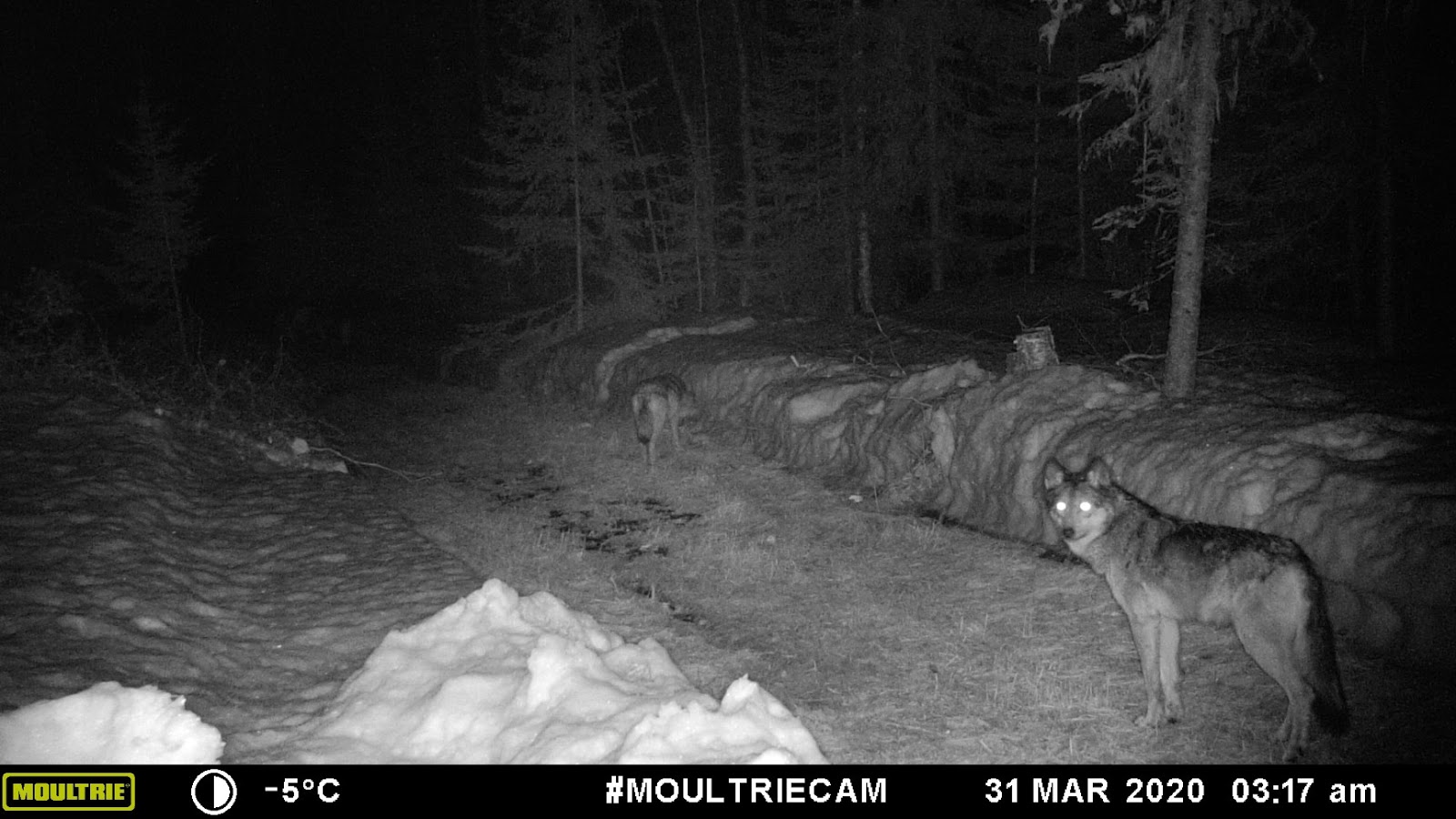
Well, what do you know? The first wolf of the winter shows up
And he has a buddy too. They killed a deer about a hundred yards from this spot.
My goodness but this Kubota is a handy thing
I set up a trail camera to watch the area where I have begun harvesting birch trees for next year's firewood. After a few days I took out the SD card only to find the camera had not been turned on. Doh! So I reset it.
The snow was exceptionally deep as shown by the deer who came to feed on the branches from one of the trees. Deer just come running when they here the chainsaw. Two wolves showed up as well and got one of the deer but off camera. They were the first wolves caught on my cameras this winter.
I drag the trees down to the new woodshed where I install my clamp-on forks to lift the trees to handy chainsaw-cutting height. It works pretty slick. Then the wood is split and stacked in four-feet-high rows, each 16 feet long.
I try to do the skidding in the mornings when the ground is still frozen to avoid making ruts.
There is lots more to do but since everything else has come to a halt due to the pandemic, I've got lots of time for the job.
If everything goes according to plan, I should have at least two years firewood under roof in a few weeks.

Sunday, April 5, 2020

Fire ban declared before snow melts

Ontario has already declared a restricted fire zone, even before the snow has melted in much of the province. Normally such a restriction is made when the bush gets tinder dry and forest fire danger is extreme. This time, however, it has to do with Covid-19. The fire ban prevents revelers from standing around bonfires and breaking the social distancing law. Also this is no time to be fighting forest or grass fires started by careless campfires or burning debris.
Towns have also asked cottagers to stay home when the ice is off the lake, at least until the Covid flap calms down. They don't want new sources of the virus showing up and overwhelming the tiny health care institutions in these places.

Thursday, April 2, 2020

April 2, Nolalu, first robin seen

Although there is a foot of snow still left to melt on the field and about two feet in the bush, a robin appeared today for the first time this year. It was hunting worms in the bare ground areas around the house, and it found one! Temperature today is + 9 C.
The robin is the first spring bird species I have seen. I say "species" because I saw what amounts to a flock of redbreasted nuthatches a couple days ago. We have local nuthatches here all winter but we only see a couple at a time. There were about a dozen in the group I saw prowling around the leaves  in my tractor trail so I figured these were spring migrants.
Temperatures are about normal for this time of year in the Nolalu area which means we could start seeing bare ground out in the open in a week or so. Now we need to steel ourselves for the inevitable snows yet to come.

Reduced version of blog is back

 Thanks, everyone, for your advocacy. This pared-down version of the blog is what I am comfortable leaving public in today's situation. ...